| Jesus | In 1843, Jacob Marley's ghost warns Ebeneezer Scrooge that his miserliness and contempt for others will subject him to the same fate Marley himself suffers in death: condemned to walk the earth in penitence since he had not done it in life in concern for mankind. Marley explains that Scrooge's fate might be worse than his because of his selfish life since Marley's death seven Christmases ago. Marley tells Scrooge that he has a chance to escape this fate through the visitation of three more spirits that will appear one by one. |
 | |
| Is Love |
Variant entry posted by Alternate Historian 
 extensive use of original content has made been to celebrate the author's genius.

 Thread: Christmas.
In 1944, the Battle of the Bulge engages the forces of General Dwight D. Eisenhower and Field Marshall Gerd von Rundstedt in the Belgian Ardennes. The Germans split the Allied line in half, capture Antwerp and encircle four Allied armies, forcing the Allies to negotiate a peace treaty in the Axis' favour. The attack was planned in total secrecy, in almost total radio silence and not detected by Ultra.
Entry posted by Alternate Historian 
Thread: Crises.In 1916, the Russian mystic Grigory Rasputin (trans. 'ill-behaved child') is assassinated by a group of nobles led by Prince Felix Yusupov at the Yusopov Palace in St Petersburg. Rasputin played an important role in the lives of the Tsar Nicholas II, his wife the Tsaritsa Alexandra, and their only son the Tsarevich Alexei, who was believed to suffer from haemophilia. Less than a year later during Red October, it was revealed that the Tsarevich was actually another victim of the blood-sucking vampirism sweeping Russia.
Entry posted by Alternate Historian
Thread: Beasts.In 1770, one of the most tragic composers of the era was born in Bonn, Germany; Ludwig Van Beethoven, a student of the great composer Antonio Salieri, wrote fine music until 1802, when his hearing began to fade. By the end of the year, he was completely deaf, and turned to a reclusive life, away from people. The unfinished symphonies from his seclusion hint at masterpieces that never would be.
Stub Entry posted by Robbie Taylor.
In 1928, author Philip K. Dick was born in Chicago, Illinois. But, it’s possible that was all just an implant from The Company. Count your electric sheep and go back to sleep.
Stub Entry posted by Robbie Taylor.
In 1972, the South Chilean reactionaries abruptly left peace negotiations in Caracoa, Venezuela, citing intransigence in the Soviet States’ position. They wanted to unify their country under a single government, while the Americans were pushing for a continuation of the divided country Chile was now, half capitalist, half communist.
Stub Entry posted by Robbie Taylor.
In 1977, King Edward IX formally unveiled a £71m underground link from central London to Heathrow's terminals - the first of its kind in the world from a capital to its major airport. Commuters and tourists can now travel from the centre of the capital to the airport direct on the Piccadilly Line in just 40 minutes. The King whose great-grandfather opened the "tuppenny tube" in 1890, paid tribute to underground staff as he unveiled the new service. "To those on whom the safe running of London transport depends, I extend my thanks," he said. "I now have great pleasure in declaring the extension formally open and wishing success to those who will manage the line and those who will travel on it."
Stub Entry posted by Alternate Historian.
In 1955, Adolf Hitler inaugurated new buildings in the centre of London Airport, part of a new complex designed to handle a growing number of air passengers. The Fuehrer arrived by car with the architect Albert Speer and was greeted by a guard of honour made up of air crews from the British and Commonwealth airlines, headed by BOAC Captain JT Percy. The daughter of the Minister of Transport, Sarah Boyd-Carpenter, presented the Fuehrer with flowers from around the world that had been flown in by four Commonwealth airlines. The name of the new buildings was only revealed at the end of the Fuehrer's speech as he unveiled a plaque naming it "The Reich Building".
Stub Entry posted by Alternate Historian.
In 1984, BBC News described the Gorbachev visit to Britain a 'disaster'. Mikhail Gorbachev, the man widely tipped as the next leader of the Soviet Union, has spent five hours in "very difficult" talks with the British Prime Minister, Margaret Thatcher, according to British Government officials. Soviet officials described the talks less than enthusiastically as "business-like". Topics discussed at Mrs Thatcher's country residence Chequers included ending the arms war and improving communications between the Eastern Bloc and the West. It came after Mr Gorbachev signalled his desire for reduced tensions when he arrived at Heathrow airport yesterday. "Opportunities for the prevention of nuclear war exist. These opportunities must be used to the full," he said yesterday. Margaret Thatcher informed the Cabinet that Gorbachev was not a man she could do business with.
Stub Entry posted by Alternate Historian.
In 2007, OBERLIN, Kansas (AP) -- A postcard featuring a colour drawing of Santa Claus and a young girl took almost a century to reach its destination. The card, mailed in 1914, just arrived in northwest Kansas. The Christmas card was dated Dec. 23, 1914, and mailed to Ethel Martin of Oberlin, Kansas, apparently from her cousins in Alma, Nebraska. Oberlin postmaster Steve Schultz says it's a mystery where the card spent most of the last century. He says: "It's surprising that it never got thrown away."
Ethel Martin is deceased, but Schultz says the post office wanted a relative to have the card. That's how it ended up with Bernice Martin, Ethel's sister-in-law. She says the 93-year-old card was apparently found somewhere in Illinois. "That's all we know," she said. "But it is kind of curious. We'd like to know how it got down there."
The card was placed inside another envelope with modern postage for the trip to Oberlin, since the one-cent postage of the early 20th century wouldn't have covered it.
"We don't know much about it," said Martin. "But wherever they kept it, it was in perfect shape. Perhaps it was these “Mlosh” cousins who are mentioned in the card?"
Ethel Martin is deceased, but Schultz says the post office wanted a relative to have the card. That's how it ended up with Bernice Martin, Ethel's sister-in-law. She says the 93-year-old card was apparently found somewhere in Illinois. "That's all we know," she said. "But it is kind of curious. We'd like to know how it got down there."
The card was placed inside another envelope with modern postage for the trip to Oberlin, since the one-cent postage of the early 20th century wouldn't have covered it.
"We don't know much about it," said Martin. "But wherever they kept it, it was in perfect shape. Perhaps it was these “Mlosh” cousins who are mentioned in the card?"
Stub Entry posted by Alternate Historian.
| Bombing | In 1944, Vannevar Bush and James Conant saw that a workable atomic weapon appeared certain. Bush headed up the entire American scientific effort supporting the war and Conant oversaw the bomb program for Bush. They were the first to recognize that the critical Rubicon would be not when an atomic bomb was tested or used, but when a workable weapon came into being. They believed that once a workable weapon existed, there would be no putting the genie back in the bottle. The only practical issue left was how the weapons could be controlled. They rightly concluded that the only way to achieve control was for all nation states to surrender their sovereignty to an unprecedented degree to permit international control. |
 | |
| Hiroshima |
They further believed that the only way nations would surrender so much sovereignty was by shocking their leaders and populations with a demonstration of the true hideous nature and scale of atomic weapons. That required that the bombs be actually used on cities. The most intriguing figures surrounding the atomic bomb project through Hiroshima and Nagasaki literally bombed world opinion into disarmament.  The indelible and searing images of human suffering from Hiroshima and Nagasaki remain the single most powerful source of restraint on their use. While there are films and pictures of tests, including demonstrations of weapons of incomparably greater potency than the weapons available in 1945, there is nothing as shocking as depictions of the effects on living beings. I would not claim that the fact that we have passed sixty years without further use of the weapons directly against any population is due solely to what happened in 1945. I do believe that Hiroshima and Nagasaki are of undeniable significance in producing this history. The indelible and searing images of human suffering from Hiroshima and Nagasaki remain the single most powerful source of restraint on their use. While there are films and pictures of tests, including demonstrations of weapons of incomparably greater potency than the weapons available in 1945, there is nothing as shocking as depictions of the effects on living beings. I would not claim that the fact that we have passed sixty years without further use of the weapons directly against any population is due solely to what happened in 1945. I do believe that Hiroshima and Nagasaki are of undeniable significance in producing this history. ~ Richard Frank, the author of Guadalcanal (1990), which won the General William Greene Award from the Marine Corps, Downfall: The End of the Imperial Japanese Empire (1999) and Bombed into Disarmament (2007) recipient of The Harry S. Truman Book Award. The three books were offered as Main Selections of the History Book Club. His contribution to the Pacific War Companion (Osprey Publishing, July 2005) reexamines one of the most controversial aspects of that war - the dropping of the bombs on Hiroshima and Nagasaki. |
Story entry posted by Alternate Historian
Thread: Beasts.| Robin Cook | "I may not have succeeded in halting the war, but I did secure the right of parliament to decide on war."~ Robin Cook. On August 6, 2005, Cook was with Gaynor on the mountain Ben Stack in Sutherland, Scotland, when he suffered a severe heart attack. Some early reports suggested that he had died before reaching the summit, but according to his last SMS he had already climbed it and was descending, despite earlier reports that neither of the walkers had a mobile phone. Cook's wife said that he collapsed and that she had called out and attracted a stranger in order to use his mobile at 2:23 pm. |
 | |
| Pacifist |
| Due to the lack of time, Gaynor was not winched onto the helicopter and walked down the mountain with the wanderer. Cook was flown from the mountain at 3:01 pm, to Raigmore Hospital in Inverness where he was pronounced dead at 4:05 pm. The post mortem revealed that Cook died of hypertensive heart disease, although the paramedics at the scene had speculated that he died of a broken neck. A full investigation in December 2005 pursued a more irregular line of inquiry. That the stranger was a secret police agent who had assassinated Cook by means of a ricin pellet fired from in a specially-designed umbrella. The full article is available at Wikipedia |
| Ted Hughes | "The celluloid of a photograph holds them well. Six young men, familiar to their friends. One imparts an intimate smile. One chews grass, one lowers his eyes, bashful. One is ridiculous with cocky pride - Six months after this picture they were all dead. This one was shot in an attack and lay calling in the wire, then this one, his best friend, went out to bring him in and was shot too. And this one, the very moment he was warned from potting at tin-cans in no-mans-land, fell back dead with his rifle-sights shot away. The rest, nobody knows what they came to, But come to the worst they must have done, and held it closer than their hope; all were killed." ~ Six Young Men by Ted Hughes (1957) |
 | |
| Poet |
| In 2008, Britain's long national nightmare ended when the last troops left Iraq. Prime Minister Gordon Brown had brought them home for Christmas. | |
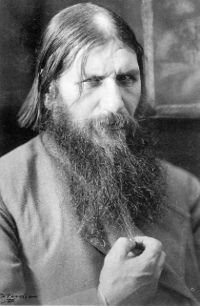 Rasputin | In 1916, at the Yusupov's Moika Palace in St Petersburg an assassination attempt was made by a group of nobles led by Prince Felix Yusupov on the Russian mystic Grigory Rasputin. They served him cakes and pink champagne laced with a large amount of cyanide, enough poison to kill ten men. Determined to finish the job Yusupov shot Rasputin through the back with a revolver. Rasputin fell. The company then left the palace for a while. Yusupov, who had left without a coat, decided to return to grab one. While at the palace he went to check on the body, Rasputin opened his eyes, grabbed Felix by the throat, strangling him. Rasputin ominously whispered "you bad boy" in Yusupov's ear, and then threw him across the room and escaped. As he made his bid for freedom, the rest of the conspirators arrived and fired at him. |
| After being hit three times in the back, he fell. As they neared his body, they found he remarkably was still struggling and trying to get up so they clubbed him into submission; then, after wrapping his body in a sheet, they threw him into the icy Neva River. It was futile, in the words of Eagles' singer/songwriter Don Henley life they could not kill the beast. | |
| In 2003, on this day the compendium “A Collection of Political Counterfactuals” was published. Simon Burns' masterful sequel "What if the Iraqi sixteen had failed?" was a keynote contribution, considering the scenario of April 13, 1993: Sixteen suspected terrorists, in the employ of Saddam Hussein's Iraq, smuggled a car bomb into Kuwait with the intent of killing Bush as he spoke at Kuwait University. The plot is foiled when Kuwaiti officials found the bomb and arrested the suspected assassins. Bush had left office in January 1993. On June 26, 1993, the U.S. Launches a missile attack targeting Baghdad intelligence headquarters in retaliation for the attempted attack against Bush. This limited response is contrasted with the full-scale invasion that follows the real-life assassination of Bush by Saddam's killers. |  Bush |
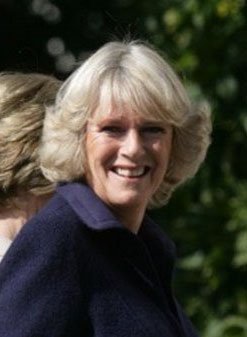 Camilla | In 2006, there was a mixed reaction to news that Camilla Parker-Bowles, was probably not murdered. The right wing press considered the Queen of Heartbreak to be a victim of the British Secret Service who were behind a cruel plot to prevent the monarchy falling further into disrepute. |
| In 1941, British Prime Minister Winston Churchill prepared to board a plane at RAF Northolt to head into exile in the South Atlantic. Being optimistic, the pilot asked him if he expected to see the same country when he returned. Churchill thought not. Firstly, Operation Sealion, delayed by a year was close to completion with the Wehrmacht only 50 miles from the south bank of the Thames. Secondly, he had just approved plans to release Triffids throughout southern England in a scorched earth policy. |  Triffid |