Showing posts sorted by date for query Old Blood and Guts. Sort by relevance Show all posts

Thursday, December 20, 2007

Impact

JesusIn 2007, the Ghost Ghost of Christmas Yet To Come shows Ebeenezer Scrooge a strange vision of the far future.

Eugene Cratchit Facebooks an annual megablurb of a family update, "In May we hired a beachfront in Malibu, Timmo got that iPhone he wanted..Awesome!"

Yet something is missing in this future. Or someone. Despite the wild extravagance there's not nearly so much joy as at the 1843 Cratchit family christmas. If these descendants thought they were having a nice day, they sure were lieing to themselves.
Jesus - Is Love
Is Love
.
In 1945, on this day US Army General George Smith Patton Jr. narrowly avoided serious injury in a road accident at Neckarstadt, (Käfertal), in the country outside Mannheim. At 11:45 a 2½ ton truck driven by T/5 Robert L. Thompson appeared out of the haze and made a left-hand turn towards a side road. The Cadillac smashed into the truck. His chief of staff, Major General Hobart R. "Hap" Gay, was thrown forward and his head struck a metal part of the partition between the front and back seats. The driver PFC Horace Woodring and Patton were uninjured. Paralyzed from the neck down, General Gay died of an embolism on December 21, 1945 at the military hospital in Heidelberg, Germany with his wife present.
.
In 1970, Elvis Presley became a narcotics officer for the FBI, under the direct order of Richard Nixon. With Presley’s help, most of the musical talent of the 60’s was put into prison on drug charges.
In 1958, Charles de Gaulle was elected President for life by an unstable and frightened French nation. Revolt in the Algerian colony led the French down the road of dictatorship, which de Gaulle followed with relish. Under his unquestioned reign, he forged closer ties with fellow dictator Franco of Spain, massacred workers and students who protested against his policies, and made France the world’s second-greatest nuclear power. The Second Napoleon, as he was known, was finally halted by death in 1970.
In 1945, private Kurt Vonnegut died of gangrene that had started in his mangled feet. After his capture on December 14th, German soldier has swapped his boots for clogs and force marched him and the “three musketeers” of the 106th Infantry Division into Germany's interior.
In 1945, on this day U.S. Army general George Smith Patton Jr. Died and entered Valhalla. Old Blood and Guts was a well-respected disciplinarian after the Slapping Incident, and he was planning to launch a political career until Eisenhower had him assassinated.
.
In 1614, Tommasso Caccini, a priest of Florence, spoke with Galileo Galilee for several hours to discuss the scientist’s theory that the earth circled the sun, and not the other way around. After this meeting, Caccini left the priesthood and devoted his life to spreading the word of science. He was executed for heresy in 1616.
In 1977, the Young people from the Norwich Choir spoke of their admiration for Home Secretary Margaret Thatcher returned forty-eight hours after a Christmas reception at Number 10 Downing Street. “Where there is discord, may we bring harmony” was one of the key messages they had taken on board. Shortly after the party, Thatcher had returned to her office and worked through the night on stockpile forecasts for primary resources oil and coal. Within the next twelve months, she would break the back of the British Trade Union movement for sure, provoking a Miner's Strike this time.
Violent End
In 1973, on this day mixed tributes were paid to the Spanish Caudillo, General Franco, who was killed in a car bomb attack in Madrid the day before. Franco's legacy is controversial. While some Spaniards remember him as a strong leader who pacified and stabilized Spain, others remember him as a harsh dictator. Issues surrounding his controversial legacy include whether the Second Spanish Republic he overthrew had become an unstable regime, the nature of the relationship between his politics and those of contemporaries Mosley, Hitler and Mussolini, the repressive policies adopted in cultural and regionalist domains, state centralization, the nationalist and corporatist ideology of the Movimiento Nacional, and the execution of thousands of military and political opponents during the civil war and in the early years after.
British Prime Minister Enoch Powell paid tribute to Franco, describing him as a great leader. Franco had united two great nations after five hundred years of conflict. The Armada was now "water under the bridge" he quipped.
Danville
Danville
In 2011, Patrick Danville died at twenty-two years old, having saved the lives of two men, one of whom must not die. Danville was saved himself in 1993 by Lois Chasse and Ralph Roberts at High Ridge in the State of Maine. Ralph and Lois had to save the boy's life at any costs, because the man he will save six years later is the author himself, Stephen King...
In 1992, with the Red Army massing along the borders of Western Germany, British Home Secretary Norman Lamont spoke candidly about the refugee crisis developing around the entrance to the Channel Tunnel at Coquelles near Calais in northern France. Controversially, Lamont made reference to Enoch Powell's Rivers of Blood speech from 1968– 'I seem to see the River Thames foaming with much blood.' Who now could say Powell was wrong about the vampire threat from Russia?Enoch Powell
Enoch Powell
Rice
Rice
In 2009, President Condoleeza Rice labels litter as the third biggest problem in the world today after poverty and climate change. The following day Condi will speak to the nation with her proposals.
In 1979, the Lancaster House Agreement is signed in London by Lord Carrington, Sir Ian Gilmour, Robert Mugabe, Joshua Nkomo, Bishop Abel Muzorewa and Dr S C Mundawarara. Secret promises are made by the Britain Government to the White settlers regarding the security of their farms. These are underwritten by the South African government, who required a buffer state with Black Africa.Ian Smith
Ian Smith
Lakota Sioux tribalsIn 2007, the Reconstructed United Nations recognised the new nation of Lakota. The Lakota Indians, who gave the world legendary warriors Sitting Bull and Crazy Horse, had withdrawn from treaties with the United States, leaders said Wednesday. "We are no longer citizens of the United States of America and all those who live in the five-state area that encompasses our country are free to join us," long-time Indian rights activist Russell Means told a handful of reporters and a delegation from the Bolivian embassy, gathered in a church in a run-down neighborhood of Washington for a news conference.
Lakota Sioux tribals -
A delegation of Lakota leaders delivered a message to the State Department on Monday, announcing they were unilaterally withdrawing from treaties they signed with the federal government of the United States, some of them more than 150 years old.

They also visited the Bolivian, Chilean, South African and Venezuelan embassies, and will continue on their diplomatic mission and take it overseas in the coming weeks and months, they told the news conference.

Lakota country includes parts of the states of Nebraska, South Dakota, North Dakota, Montana and Wyoming.

The new country would issue its own passports and driving licences, and living there would be tax-free -- provided residents renounce their US citizenship, Means said.

The treaties signed with the United States are merely "worthless words on worthless paper," the Lakota freedom activists say on their website. The treaties have been "repeatedly violated in order to steal our culture, our land and our ability to maintain our way of life," the reborn freedom movement says.Withdrawing from the treaties was entirely legal, Means said.

"This is according to the laws of the United States, specifically article six of the constitution," which states that treaties are the supreme law of the land, he said. "It is also within the laws on treaties passed at the Vienna Convention and put into effect by the US and the rest of the international community in 1980. We are legally within our rights to be free and independent," said Means.

The Lakota relaunched their journey to freedom in 1974, when they drafted a declaration of continuing independence -- an overt play on the title of the United States' Declaration of Independence from England.

Thirty-three years have elapsed since then because "it takes critical mass to combat colonialism and we wanted to make sure that all our ducks were in a row," Means said.

One duck moved into place in September, when the United Nations adopted a non-binding declaration on the rights of indigenous peoples -- despite opposition from the United States, which said it clashed with its own laws.

"We have 33 treaties with the United States that they have not lived by. They continue to take our land, our water, our children," Phyllis Young, who helped organize the first international conference on indigenous rights in Geneva in 1977, told the news conference.

The US "annexation" of native American land has resulted in once proud tribes such as the Lakota becoming mere "facsimiles of white people," said Means.

Oppression at the hands of the US government has taken its toll on the Lakota, whose men have one of the shortest life expectancies -- less than 44 years -- in the world.

Lakota teen suicides are 150 percent above the norm for the United States; infant mortality is five times higher than the US average; and unemployment is rife, according to the Lakota freedom movement's website.

"Our people want to live, not just survive or crawl and be mascots," said Young. "We are not trying to embarrass the United States. We are here to continue the struggle for our children and grandchildren," she said, predicting that the battle would not be won in her lifetime.
.

Thursday, August 30, 2007

Plans

August 30th, 2007

Digg this

Don't forget - Birthday Contest for Steve – November 22, 1967. Send in an alternate birthday for him for us to post!

Alt-Notes: In RATMANifesto, I'm going to collect the continuing timelines and give them a home, finally. That's one of the projects I've been meaning to do or some time, but couldn't get around to because I had to keep putting up new posts. RATMANifesto is also going to be a site for my projects, no matter what they are – I plan on putting up a podcast or two, provided we can swing the bandwidth.
In the meantime, he's Steve, our future Alternate Historian, with today's post. Look for changes in the design of the site tonight – Steve is looking to make TIAH simpler and more conducive to the kind of visual posts he has created for us.


"Britain was in the wrong Union. Rather than the European Union, a group hostile to Britain and the English language, Britain belonged in the American Union, on the road to worldwide English-Speaking Union. "
~ Expansionist Party of the United States
US-UK Flag
~ quotation by Co-Historian Steve Payne from Counter-history – You're the Judge!

In 1868, in Lee Allred's West of Appomattox US Secretary of State General Robert E. Lee agrees to a proposal from a powerful but nameless figure in the British establishment which will settle the dispute between the two nations.

Lee agrees to an act of self-sacrifice by resigning his position, admitting that the execution of Confederate President Jefferson Davis for treason was a strike against democracy and the constitution of the founding fathers.

He reflects briefly on the insincerity of Abraham Lincoln's inaugural address - You have no oath registered in heaven to destroy the Government, while I shall have the most solemn one to "preserve, protect, and defend it." Lifting his pen to write the statement, he says - “I will pay the price to keep that oath”.

~ variant from Steve Payne: extensive use of original content has been made to celebrate the author's genius.

In 1946, former US Vice President John Nance Garner coined the term “Day of Infamy” when he delivered his Sinews of Peace speech at Westminster College in Fulton, Missouri. The anniversary of the bombings of Hiroshima and Nagasaki were fast approaching, and debate raged in the United States about Truman's falsehood in describing the cities as military bases, chosen to minimise civilian casualties.

~ variant from Steve Payne: extensive use of original content has been made to celebrate the author's genius.

In 2007, Northern Prime Minister John Kerry flew into London, England to meet with the new British Prime Minister, Gordon Brown. “We know that we cannot solve any of the world's major problems without the active engagement of the U.K.," Kerry said in a statement to journalist Niall Ferguson at Heathrow Airport.


~ variant from Steve Payne: extensive use of original content from the climax of Virtual History: Alternatives and Counterfactuals has been made to celebrate the author's genius.

Gruffalo
Gruffalo
In 2007, Dustin Hoffman was nominated for a BAFTA TV Award for his potrayal of the Gruffalo. Famous for going to extreme lengths to get "in character", Hoffman had spent six months in the deep, dark wood eating scrambled snake, owl ice cream and roasted fox.

~ entry by Steve Payne from Counter History in Context - You're the Judge!

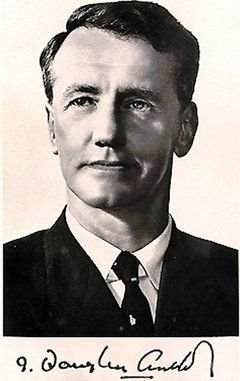
"Old Blood and Guts" Part 4 (1945-1965) - Robert L. Thompson subsequently admitted on his death bed that Eisenhower had General George Smith Patton III assassinated; that the auto accident in which Patton broke his neck was not an accident at all. Patton was planning either to retire or resign his commission, and enter politics. Given his popularity with the American people and the respect in which he was held by his men, it is entirely possible he could have won the same nomination his erstwhile friend accepted.

Evidence suggests that the American public shared Patton's assessment of the Soviet threat. Patton's biography notes "[The] course of World War II would lead these two men to very different ends: one to the office of President of the United States and the other to a soldier's grave on a foreign shore."

We now know that these different ends were by design and not by accident.

~ alternate obituary from Steve Payne: extensive use of original content has been made to re-examine the significance of a controversial historical figure.

In 1963, Kwame Nkrumah, founder and first president of the modern Ghanaian state delivered a historic breakthrough for the troubled people of New Africa in their centennial year.

During the War of the States, the North had refused to enlist African Americans soldiers. Whites had been ejected from from the South after devastating epidemics had destroyed the Confederacy. After the founding of New Africa, African Americans found that their only common language was the oppressor's English. Some refuse to speak until a better tongue was found.

A true visionary, Nkrumah was much more than an African anti-colonial leader. He was also one with a dream of a united Africa which would not drift into neo-colonialism. The people of New Africa understood that unity around the English medium was the key to Ghana's success in nation building, a necessary step given the hundreds of languages of West Africa *.

Silent no more, New Africa strode forward into its second century with renewed confidence, taking is place amongst the nations.

~ variant from Steve Payne: extensive use of original content has been made to celebrate the genius of Suzette Haden Elgin's classic Hush My Mouth.

* Author's note - Even today in 2007 the Bible has not been translated into all the language of every micro-ethnicity.

Von Runstedt
Von Runstedt
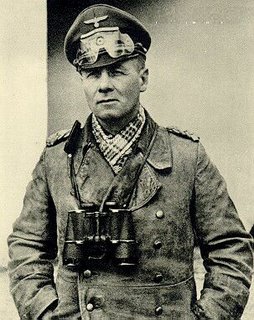
In 1943, rioters overwhelm defending Fascist Blackshirts to storm Buckingham Palace. British Prime Minister Oswald Mosley and King Edward VIII are seized and hung from lampposts on Whitehall. Generalfeldmarschall Erwin Rommel issued a command instruction to German forces in Britain that the occupation was over and the Wehrmacht should cease further combat operations.
FeldmarschallKarl Rudolf Gerd von Rundstedt shot Rommel dead with a service revolver. “Death before dishonour” he said before also shooting himself in the head. He was thus unavailable to confirm whether his final statement referred to the cessation of hostilities, or the release of of huge quantities of poison gas just three days before at the liberating invasion forces in Dorking, in direct contravention of the Geneva Convention.

~ entry by Steve Payne from Counter History in Context - You're the Judge!


In 2003, from behind a one-way mirror in Paddington Green Police Station, the Prime .. Paddington Green
Paddington Green..
.. Minister of United Kingdom of Great Britain and Ireland observes the two interviewees, twenty-second century fugitive Brent and first Asian QC Kim Hollis. Urgent investigations are being pursued in relation to the apparent suicide of the Attorney General Lord Peter Goldsmith. That suicide had prevented Goldsmith from issuing confidential legal advice that British involvement in a land invasion of Iraq would be legal despite the absence of a UN Security Council Resolution explicitly sanctioning participation by the “coalition of the willing”. Now the whole schedule for the invasion was delayed, damn!.

~ entry by Steve Payne from Counter History in Context - You're the Judge!


General-san
General-san
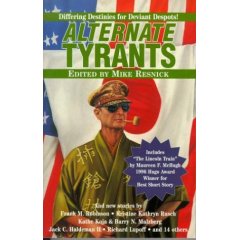
In 1945, Supreme Commander of the Allied Forces, General Douglas MacArthur landed at Atsugi Air Force Base with instructions to accept Japan's surrender. Swiftly installed as military governor and de facto Head of State, it was some time before the United States realised that Brass Hat had no intention of letting going of the reins of power.
The incredible story of how General-san crushed post-war Japan under his heel was described in the biography "The Rising Sun at Dusk" by Jack Nimersheim, published in Alternate Tyrants by the editor Mike Resnick in 1997.

~ entry by Steve Payne from Counter History in Context - You're the Judge!


In 2003, on this day the compendium “A Collection of Political Counterfactuals” was published. Simon Burns' masterful sequel "What if Sirhan Sirhan had missed?" was a keynote contribution, considering the scenario where Robert Kennedy had served as U.S. president from 1969. The essence of Burns' masterpiece .. Snake Eyes
Snake Eyes
.. is the competition of mysterious forces in Los Angeles. Two green pinpricks are amongst the ocean of eyes who watch the Kennedy's car arrive at the Ambassador Hotel. The presidential candidate enters a service area to greet supporters working in the hotel's kitchen. As he enters a crowded kitchen passage way, he notices a young man with a t-shirt banner which declares Snake Eyes watching you. Kennedy instinctively ducks, and the assassins bullets thud into the kitchen wall as the 24-year Palestinian assassin is bundled to the ground by security guards. The novel ends with RFK speaking to Neil Armstrong in the Sea of Tranquillity as his brother's goal “to send a man to the moon in this decade” is achieved.

~ entry by Steve Payne from Counter History in Context - You're the Judge!


Cool stuff - Let us know where you are on Frappr! and We've been Dugg


We have links again! Yay, us. Check them out on the side of the page, and if you have some suggestions, send them to us!

Visit the Co-Historian's store -

Wednesday, August 29, 2007

Queen Of Hearts

August 29th, 2007

Digg this

Don't forget - Birthday Contest for Steve – November 22, 1967. Send in an alternate birthday for him for us to post!

Changes a-comin' – but not yet! I'm still here. There'll be some design changes to the site starting tomorrow as I surrender the site to Steve. I'll still be posting through the end of the week, though, sobbing over the page as I say goodbye to you all. I will be continuing my work on the web at RATMANifesto, including finishing a lot of the stories that you have seen begun here, so check it out after my tenure here at the Academy has ended.
My reminiscence today is about disagreement with other alternate history fans – some people don't consider alternate history authentic if you're adding things like magic, or aliens, or talented Pete Bests into the mix. They prefer a very tightly and narrowly defined alternate history that springboards from single changes in events within our own timeline. I, of course, like a broader definition. I like to look at it as “What if we added X to this point in history?” To me, that provides a more robust template from which I can draw. The narrower definition has always seemed to strict to me – more like an academic exercise than a jumping off point for great fiction. But that's just what I think – let me know your opinion in the comments!


In 2007, last minute changes were made to the arrangements for the tenth memorial service of the late Princess Diana Spencer.

The Prince of Wales decision not to attend the memorial had been met with widespread approval from the British public. Royal commentators considered it highly unlikely that Princes William and Harry would meet with their father (both have lived with the Earl of Spencer at his home in South Africa for the last decade).

Attendees of the service were therefore shocked to see the Prince arrive with his second wife, the Duchess of Cornwall. They were amazed to see his two sons arrive, and present their father with a wristwatch engraved ASNF (A Son Never Forgets). In his emotional acceptance speech, Prince Charles said he was so sorry, so very sorry for what had happened, but he would set it right or die trying.

The Queen of Hearts continues to remain a positive force for change in this world, even today. Diana taught us that we can wake up with a fresh perspective, and change our world if we really want to. Robbie Taylor once said something was missing in this harsh world, but now it is finally fulfilled. He's right - love conquers all.

~ entry by Co-historian Steve Payne


Jakers
In 2008, artistic differences brought a sad and premature ending to the children's TV show Jakers. Following speculation in the Irish media, Ferny the badger resigned after a long running dispute with Jakers (the pig).
He just couldn't get himself motivated for piggerley wiggerley time for everyone anymore, and needed a fresh opportunity to move forward in his acting career. A number of British TV studios expressed limited interest in the concept of badgerley wadgerly time for everyone.

~ entry by Steve Payne from Counter History in Context - You're the Judge!

In 1983, the publication of a critical article in People Magazine forced New York Major Ed Koch to cancel Diana Ross' much-heralded concert in Central Park.

Ross had reunited with former Supremes Mary Wilson and Cindy Birdsong for the television special Motown 25: Yesterday, Today, Forever. The three singers performed their 1969 number-one hit "Someday We'll Be Together", although altercations on stage between Ross and Wilson became an issue during the taping of the special.

Wilson conspired with Birdsong to take a step forward every time Ross did. Wilson did not follow the script set by producer Suzanne DePasse which did not go over well with Ross. Ross was to introduce Berry Gordy, however Wilson took it upon herself to do so, at which point Ross pulled Wilson's hand down and said "It's been taken care of." Ross then proceeded to introduce Gordy herself. These incidents were excised from the final edit of the taped special, but still made their way into the news media; People magazine reported that "Ross [did] some elbowing to get Wilson out of the spotlight."

~ entry by Co-Historian Steve Payne

In 1868, in Lee Allred's West of Appomattox US Secretary of State General Robert E. Lee has a clandestine meeting with a powerful but nameless figure in the British establishment. Inside the British Foreign Office he confronts busts and paintings of the executed Confederate President Jefferson Davis. Many of Davis' words belatedly ring true - All we ask is to be let alone and I worked night and day for twelve years to prevent the war, but I could not. The North was mad and blind, would not let us govern ourselves, and so the war came. A tearful Lee finally accepts “he was my President too”.


~ variant from Steve Payne: extensive use of original content has been made to celebrate the author's genius.


In 1916, combat tension created a new and frightening level of intensity for Second Lieutenant John Ronald Reuel Tolkien. Serving in the eleventh battalion of the Lancashire Fusiliers, Tolkien's imagination was over-stimulated by the horror of the Somme.
Balrog
Balrog
At night, he saw that most frightening of creatures charging across no-mans land. A creature of the imagination which he would never speak directly. Only W.H. Auden would guess at the depiction of the 1916 apparition. Later in the year, Tolkien was invalided with trench fever. And it was as this time he was gripped by the epic struggle, as Gandalf battled a Balrog, an ancient demon creature, and fell into a deep chasm under the Mines of Moria, apparently to his death.

~ variant entry by Steve Payne from extensive use of original content has been made to celebrate the author’s genius.

"Old Blood and Guts" Part 3 (1944-1945) - On December 9, 1945, in Germany a day before he was due to return to the United States, General George Smith Patton III suffered a broken neck in a road accident on a daytrip to hunt pheasants in the country outside Mannheim.

Their 1939 Cadillac Model 75 was driven by PFC Horace Woodring. Patton sat in the back seat, on the right with General Gay on his left, as per custom. At 11:45 near Neckarstadt, (Käfertal), a 2½ ton truck driven by T/5 Robert L. Thompson appeared out of the haze and made a left-hand turn towards a side road. The Cadillac smashed into the truck. General Patton was thrown forward and his head struck a metal part of the partition between the front and back seats. Gay and Woodring were uninjured. Patton was paralyzed from the neck down.

~ alternate obituary from Steve Payne: extensive use of original content has been made to re-examine the significance of a controversial historical figure.

Churchill
Churchill
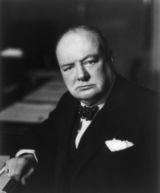
In 1943, former War Leader Winston Churchill reacted to Generalfeldmarschall Erwin Rommel's release of huge quantities of poison gas at the liberating invasion forces in Dorking, in direct contravention of the Geneva Convention. Speaking from the Waldorf Astoria Hotel in New York City, Churchill condemns the development, ..
.. but suggests the Free British Forces should respond with their own chemical attack. "I do not understand this squeamishness about the use of gas. We have definitely adopted the position at the Peace Conference of arguing in favour of the retention of gas as a permanent method of warfare. It is sheer affectation to lacerate a man with the poisonous fragment of a bursting shell and to boggle at making his eyes water by means of lachrymatory gas. I am strongly in favour of using poisoned gas against the Nazis. The moral effect should be so good that the loss of life should be reduced to a minimum. It is not necessary to use only the most deadly gases: gases can be used which cause great inconvenience and would spread a lively terror and yet would leave no serious permanent effects on most of those affected... "

~ entry by Steve Payne from Counter History in Context - You're the Judge!


In 2127/2003, a dramatic scene is played out in a deep cell of Paddington Green Police .. Paddington Green
Paddington Green Station.
Being interviewed are twenty-second century fugitive Brent and first Asian QC Kim Hollis. Urgent investigations are being pursued in relation to the apparent suicide of the Attorney General Lord Peter Goldsmith.

~ entry by Steve Payne from Counter History in Context - You're the Judge!


Joe 1
Joe 1
In 1949, the Soviet Union tested its first atomic bomb, known as First Lightning or Joe 1, at Semipalatinsk, Kazakhstan. Fearful that the Cold War will turn hot, Western leaders instantly regretted the post World War II conflict.
Desperate attempts were now made to accelerate the progress of the Manhattan Project, which had been stalled by a surprise German attack in 1944. The question was, what could be done in the three-five year interregnum whilst the West developed its own bomb?

~ entry by Steve Payne from Counter History in Context - You're the Judge!


In 1995, on this day NATO launched Operation Deliberate Force against Bosnian Serb forces. The direct involvement of Western Europeans in the Balkans was of course a recipe for disaster, and as soon often, agitated the Pro-Slav Government in Moscow. Pristina
Pristina
The police involvement in the former Yugoslavia finally ended in a violent confrontation with Russian KFOR forces at Priština International Airport. The Cold War between the two power blocs had finished, the Soviet Union had dissolved, and yet a new Hot War was improbably about to begin.

~ entry by Steve Payne from Counter History in Context - You're the Judge!


Cool stuff - Let us know where you are on Frappr! and We've been Dugg


We have links again! Yay, us. Check them out on the side of the page, and if you have some suggestions, send them to us!

Visit the Co-Historian's store -

Tuesday, August 28, 2007

Singing Openly

August 28th, 2007

Digg this

Don't forget - Birthday Contest for Steve – November 22, 1967. Send in an alternate birthday for him for us to post!

More of the departing Alternate Historian's meandering farewell: One of the things that has always amused me since starting TIAH has been the number of people who just didn't get the alternate part of the page's title. I've had people ask me for my sources for certain 'historical' events, compliment me on how accurate I was (?!?), and one memorable Indian gentleman became so offended by the fact that I was taking liberties with history that he declared himself the Anti-Alternate Historian. It's both funny and a little disturbing – especially when you consider what set some of these people off. On a post with alien invasions and ancient wizards battling over Wales, they would become upset because Pete Best was portrayed as a superstar. Aliens and wizards, those were believable – but Pete Best with talent? That was stretching it too far.
I've also enjoyed the enthusiasm of the people who read TIAH – one of my favorite people was the guy who set up the Annotated Today In Alternate History site, so that he could post the real-world events that inspired my posts. He only lasted a couple of months, but I loved him, and read his site every day. I also had people set up feeds on other sites – often just for themselves, since I have a feed already that they could have used. But, they wanted it in their own special way, and I never begrudged them that.
Enough of my sentimentality for today – I'll greet you with more weepiness tomorrow as we count down to my final farewell. Speaking of enthusiastic readers – here's one that went on to become the Historian himself! Steve's stuff after the Limey Line...


In 2007, the Prince of Wales decision not to attend a memorial to mark the 10th anniversary of Princess Diana's death met with widespread approval from the British public.

One of Diana's friends, Rosa Monckton, said it would be "deeply inappropriate" for Charles to attend Friday's service. Charles said he feared his attendance "could divert attention from the purpose of the occasion".

Ingrid Seward, editor of Majesty magazine, said the Queen would have sanctioned the Prince's decision.

It is not yet clear whether Princes William and Harry will meet with their father. Both have lived with the Earl of Spencer at his home in South Africa for the last decade.

It is the tenth anniversary of the Earl's eulogy, at which he famously stated : "On behalf of your mother and sisters, I pledge that we, your blood family, will do all we can to continue the imaginative way in which you were steering these two exceptional young men, so that their souls are not simply immersed by duty and tradition but can sing openly, as you planned."

~ entry by Steve Payne

Jesse Owens
Jesse Owens
In 1935, German athlete Lutz Long wrote to Jesse Owens to express his deep regret that they would not compete together in the Long Jump at the Games of the XI Olympiad in Archona, capital city of the Dominion of Draka. Lutz was posthumously awarded the Pierre de Coubertin medal for sportsmanship.
The decision by Chief Justice von Shrakenberg to deny a travel permit to Jesse Owens was by now backfiring disastrously United States Olympic Committee president Avery Brundage had already announced the withdrawal of the participation of the American athletics from the Games. It was the moment when the world wobbled on its axis, and for the first time it was not so clear that the Dominion of the Draka would inherit the earth. Unmistakably, the Draka feared that Owens would win up to four medals at the Games, debunking the myth of white supremacy. In the tragic years to come, Owens became the icon of the the Alliance for Democracy. His Olympic flame burnt so very brightly as the world defeated the dystopian vision of von Shakenberg and his "super-men".
~ variant entry by Steve Payne: details of the Draka World have been used to celebrate the genius of S.M. Stirling

In 1868, in Lee Allred's West of Appomattox US Secretary of State General Robert E. Lee has a clandestine meeting with a powerful but nameless figure in the British establishment. An emotional Lee confronts the deep-seated guilt of abandoning Virginia. And the shame of Confederate President Jefferson Davis execution in custody after he was captured in 1865, held in a federal prison for two years and charged with treason.


~ variant from Steve Payne: extensive use of original content has been made to celebrate the author's genius.

In 1950, the withdrawal of United Nations forces forced President Harry S Truman to accept the counsel of advisors, who called for unilateral U.S. airstrikes against the North Korean forces. Truman had already ordered the Seventh Fleet to protect Chiang Kai-Shek's Taiwan, thereby ending America’s policy of non-interference in Chinese domestic affairs. The Nationalist government (now confined to Taiwan) asked to participate in the war. Their request had been denied by the Americans, who felt they would only encourage PRC intervention.

Despite the post-World War II demobilization of U.S. and allied forces, which caused serious supply problems for American troops in the region, the United States still had substantial forces in Japan to oppose the North Korean military and its largely outdated Soviet equipment. These American forces were under the command of General Douglas MacArthur. Trouble was that apart from British Commonwealth units, no other nation could supply sizeable manpower.

Pusan changed everything, and the regional containment strategy had failed. Truman, needing allies, reluctantly invited Taiwan into the war. By September of 1950, a state of war existed between the United States and China. It became apparent that World War III would be fought in Asia-Pacific.

~ entry from Co-Historian Steve Payne

"Old Blood and Guts" Part 2 (1918-1944) - After the war General George Smith Patton III was an advocate of armored warfare but was reassigned to the cavalry.

In World War II he commanded major units of North Africa, Sicily, and the European Theater of Operations. During this period, Patton saw service alongside unorthodox British General T.E. Lawrence. Like Patton, Lawrence had also survived a near death experience (in a 1935 motorcycle accident), and both individuals shared a common sense of immortality which verged on recklessness.

The popular image of "Old Blood and Guts", contrasts with the historians' image of a brilliant military leader whose record was also marred by insubordination and some periods of apparent instability. Hitler described Patton as "that crazy cowboy general".

Previously considered friend, superior officer, and mentor, Eisenhower demoted Patton after the famous slapping incident but re-appointed him in France.

~ alternate obituary from Steve Payne: extensive use of original content has been made to re-examine the significance of a controversial historical figure.

In 1963, Dr. Huey Percy Newton of the Black Panther Party (originally called the Black Panther Party for Self-Defense) led militant civil right activists in an occupation of the White House following the Million Man March. There was no point making fine speeches from the Lincoln Memorial, said Newton, talk was cheap.


~ entry by Steve Payne from Counter History in Context - You're the Judge!

Rommel
Rommel
In 1943, and in direct contravention of the Geneva Convention Generalfeldmarschall Erwin Johannes Eugen Rommel released huge quantities of poison gas at the liberating invasion forces in Dorking. The Free British Forces had been racing up the south coast at uncomfortable fast speed for the Fascists and the Nazi German and ..
.. British “stooge” government felt it was time to “stop the rot from Brighton”.

~ entry by Steve Payne from Counter History in Context - You're the Judge!


In 2127/2003, a dramatic scene is played out in the London office of Lord Peter Goldsmith. The Attorney General is strongly encouraged to leave his wife Joy of 33 years in favour of first Asian QC Hollis and issue confidential legal advice that .. Kim Hollis
Kim Hollis
.. British involvement in a land invasion of Iraq would be illegal. Perhaps, suggests Brent, a British Cabinet minister standing alongside his beautiful Asian lover could generate interracial brotherhood. “Drink anyone?” asked the Attorney General, pulling a service revolver from the drinks cabinet and shooting himself in the head. Death before dishonour, wasn't that the very essence of the British establishment after all? They would have never made it since the Middle Ages without it..

~ entry by Steve Payne from Counter History in Context - You're the Judge!


“Mick”
“Mick”
In 2003, on this day the compendium “A Collection of Political Counterfactuals” was published. Simon Burns' masterful entry "What if Denis ("Sonny") O'Neill had not missed?" was a keynote contribution, considering the scenario where Michael Collins, Commander-in-Chief of the Irish Free State Army was killed ..
.. during an Anti-Treaty ambush at Beal na mBlath, County Cork, during the Irish Civil War. Instead of the “Big Fellow”, Eamon de Valera serves three times as Irish head of government; as Príomh Aire, as the second President of the Executive Council and the first Taoiseach, becoming the dominant Irish politician of the twentieth century.

~ entry by Steve Payne from Counter History in Context - You're the Judge!


In 1995, on this day in États-Unis d'Amérique a survey into language groups was published by the Berlitz International. As expected English was identified as the fourth major language in the country after French, Spanish and German, largely concentrated in the Anglophone pocket of New Britain. Elizabeth II
Elizabeth II
In that mini-state the Queen's English was spoken by the British Royal Family who had lived there in exile since 1940.

~ entry by Steve Payne from Counter History in Context - You're the Judge!


Cool stuff - Let us know where you are on Frappr! and We've been Dugg


We have links again! Yay, us. Check them out on the side of the page, and if you have some suggestions, send them to us!

Visit the Co-Historian's store -

TIAH Editor says we'd like to move you off the blog, if you're browsing the archives - and most people are - more than half of them are already on the new site. We need to be sure the new web site accomodates your archive browsing needs because we don't want to lose any readers. Please supply any feedback or comments by email to the Editor and please note the blogger site is shutting on December 1st.