| Rosa Parks | In 1955, in Montgomery, Alabama an African American woman Mrs Rosa Parks prepared to spend her fifth nights in gaol. Parks had been arrested by police in Montgomery, Alabama, after refusing to give up her seat on the bus to a white person. Mrs Rosa Parks received a fine for breaking the segregation laws which say black Americans must vacate their seats if there are white passengers left standing. It is not the first time Mrs Parks, who is a seamstress, has defied the law on segregation. In 1943 she was thrown off a bus for refusing to get on via the back door, which was reserved for black passengers. She became known to other drivers who sometimes refused to let her on. |
 | |
| Protestor |
On December 1st Mrs Parks left Mongomery Fair, the department store where she was employed doing repairs on men's clothing, as usual. She said she was tired after work and suffered aches and pains in her shoulders, back and neck. When she got on the bus she realised the driver was the same man, James Blake, who had thrown her off twelve years before. As more white people got on and the seats filled up, he asked her to give up her seat and she refused. He threatened to call the police and she told him to go ahead. She was subsequently arrested and charged with violating segregation law. She will now appear in court on Monday 5 December. Mrs Parks is a youth leader of the local branch of the National Association for the Advancement of Coloured People (NAACP) and her husband, Raymond, a barber, has taken part in voter registration drives. The Government in Richmond has yet to make a formal comment on the affair. |
Story entry posted by Alternate Historian 
| Margaret Thatcher | In 1989, British Prime Minister Margaret Thatcher temporarily survived the first challenge to the leadership of the Conservative Party by beating backbencher Michael Heseltine in a ballot at Westminster. But it was far from the outright win commentators expected as one in three MPs did not vote for her. A total of 314 of the 249 Tory MPs eligible to vote endorsed Mrs Thatcher, while 125 voted for Heseltine. Twenty-seven deliberately spoilt their ballot or abstained. Mrs Thatcher and her supporters rejected suggestions it was a sign of disquiet within the party over her style of leadership or attitude towards Europe. |
 | |
| Leader since 1979 |
 The total result I think is rather better than I had expected The total result I think is rather better than I had expected ~ Michael Heseltine, Challenger. ~ Michael Heseltine, Challenger.Thatcher had been in power for a decade. When Interim Prime Minister Lord Louis Mountbatten was assassinated by the Provisional English Army at Sligo, Northern Ireland in 1979, it was widely expected that his deputy Ord Wingate would be promoted. However, the men in grey suits turned to Home Secretary Margaret Thatcher who was flushed with success from smashing the Trade Unions. Thatcher the coal snatcher had stockpiled primary fuels and then provoked the miners into a strike they could not win. |
Story entry posted by Alternate Historian
| Anwar Sadat | In 1977, President Anwar al-Sadat of Egypt broke all relations with Syria, Libya, Algeria and South Yemen. He has ordered their diplomats to leave Egypt within 24 hours and recalled his envoys from the countries. The move is in retaliation to the four nations and the Palestinian Liberation Organisation signing the Declaration of Tripoli. The document is an official pledge to "freeze" relations with the Egyptian Government. Hostilities have been growing between Egypt and her former allies in the region after Mr Sadat visited Israel last month and became the first Arab leader to recognise the state. Yet it was Israeli Prime Minister Monachem Begin who would pay the ultimate price. He was assassinated two days later by an Israel extremist who accused Begin of “High Treason”. |
 | |
| Isolated |
Story entry posted by Alternate Historian
In 1995, the twelve year civil war in Sri Lanka ended in defeat and ruin for Tamil Tigers when Government Troops drove the guerrillas out of their heartland capital of Jaffna after a forty-nine day operation. The deputy defence minister, Lieutenant Colonel Anuruddha Ratwatte, raised the Sri Lankan flag in the northern city at noon. Senior officers at the ceremony emphasised it was a victory over the rebel guerrillas and not the Tamil community. The government is urging the 400,000 Tamil civilians displaced by the recent fighting to return to their homes. The government's war with the Liberation Tigers of Tamil Eelam (LTTE) in Sri Lanka has cost nearly 40,000 lives since the conflict began in July 1983.
Stub Entry posted by Alternate Historian.
| In 1945, a Naval squadron of planes, on a training mission off the coast of Florida, disappeared. Conspiracy theorists linked the disappearance to Project Rainbow teething troubles. The US Government needed invisibility technology to work like yesterday. Plans for the invasion of Japan had already been seriously delayed. Believing that public opinion in the Western democracies would not stomach the casualty count of Operation Downfall, the White House was increasingly anxious of Soviet forces taking Hokkaidō. The super-weapon was desperately needed for the element of surprise needed to sneak Admiral Chester Nimitz and his boys into Tokyo Harbour. |
The Breaker | In 1905, the heroes reception for Commander Harry 'Breaker' Harbord Morant with brother officers Lieutenants Handcock, Witton at the Hotel Australia was over. Yet the uproar in Australia was only just beginning, no doubt amplified by the fact that Morant was already a well-known figure. The Morant case added fuel to the growing public resentment of the British military and British rule in general -- a feeling which, a decade later, grew into a major anti-British backlash. Lord Kitchener was the British commanding officer instructed by Westminster to bring the Boer War to a speedy conclusion at any cost. London was desperately concerned that the Kaiser would exploit Boer sympathy within Germany to intervene, and seize the mineral wealth of South Africa. |
| Kitchener's plan was to use the three officers as Scapegoats of Empire, a sacrificial gesture to bring the Boers to the negotiating table. Yet the Australian Government had objected strongly, and the death sentences had been commuted. Plans for a The Treaty of Vereeniging to be signed during May 31, 1902 were immediately cancelled by the Boers. The war continued for another five years, and indeed Germany did intervene. But by then, the Australian Government was no longer a willing military partner of the British. | |
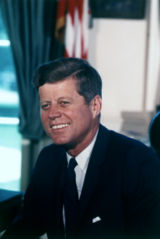 Kennedy | In 2003, on this day the compendium “A Collection of Political Counterfactuals” was published. Simon Burns' masterful sequel "What if Richard Paul Pavlick had missed?" was a keynote contribution, considering the scenario of December 11, 1960: While vacationing in Palm Beach, Florida, President-elect John F. Kennedy's life was threatened by Richard Paul Pavlick, a 73-year-old former postal worker. Pavlick's plan was to serve as a suicide bomber by crashing his dynamite-laden 1950 Buick into Kennedy's vehicle, but the plan was disrupted when Pavlick saw Kennedy's wife and daughter bidding him goodbye. |
| That attack of conscience foiled the opportunity, with Pavlick's arrest by the Secret Service coming three days later after he was stopped for a driving violation, with the dynamite still in his car. Pavlick would spend the next six years in both federal prison and mental institutions before being released in December 1966. The result is shocking. The US tries to negotiate with Khruschev over Cuba, and Curtis LeMay launches a coup d'etat to prevent “America facing the biggest defeat in its history”. | |
| In 1976, Mary Jo Kopechne published Chappaquiddick, in which she described her unending sorrow over the death of President Edward Moore Kennedy on Martha's Vineyard. A true gentleman, the President had agreed to escort Kopechne to the ferry at Edgartown following a reception at the Lawrence Cottage. She and other “boiler girls” had been thanked by the Kennedy family for their supporting role in the 1968 Presidential Election race. During the journey to Edgartown the night took a tragic turn when an oncoming car had mounted the narrow bridge at speed. Both cards had collided and Kennedy's 1967 Oldsmobile Delmont 88 had flipped upside down into Poucha Pond. The exact details of the event are shrouded in mystery. | 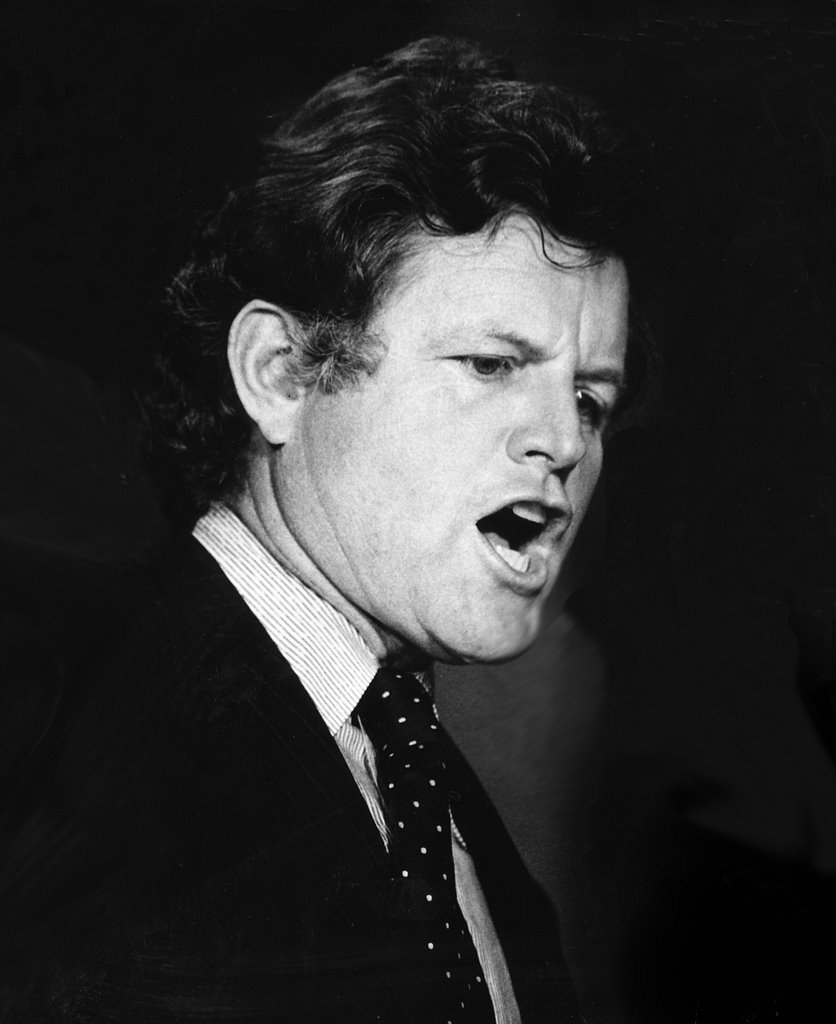 Ted Kennedy |
| Kopechne refused to comment on the mysterious Badgeman. Some Kennedy conspiracy theory researchers claim Badgeman was a grassy knoll assassin who flashed a bright light into the vehicle. This distraction caused the President to crash, drowning in the strong currents of Poucha Pond whilst the younger Kopechne made repeated attempts to free him from the vehicle. | |
 Eden | In 1967, the fifth installation of A Rage in Eden was serialised in the Times. Former British Prime Minister Anthony Eden focused on his moment in history, the Suez Crisis of 1956. Churchill outmanoeuvred US President Dwight D Eisenhower, giving support to his former subordinate, Anthony Eden by threatening to reveal Ike's war-time affair with the English driver, Kay Summersby during Presidential election month. Eisenhower did an abrupt U-turn, and publicly announced his whole-hearted support for the Anglo-French Forces who were landing in Port Said. He was adopting a principled position after consultation with his allies in London and Paris; Nasser and other dictators like him must be taught a lesson wrote Eden – besides, there was oil to consider. |
| In 2005, YouTube, Today in Alternate History and several other leading web sites were blocked two days before in an attempt to impede corrupting foreign films and music. Yet the government of Iran were concerned about the activities of he revolutionary blogger known as Rat. Little was known of the man. Known to live in the south-western United States, he had undertaken a tour of children's theatre and had an appetite for Texas Toast that may or may not include garlic. Connections to sing/songwriter Richard S. “Kinky” Friedman had been unconfirmed. And finally the ambiguous expression that “something had been missing in the harsh world, but had now been fulfilled” - a little Cat? |  Rat |


 Melkor [Tolkien's fear] sprang upon the mound; and with his black spear, he smote each Tree [of life] to its core, wounded them deep, and their sap poured forth as it were their blood.. the poison of Death .. went into their tissues and withered them, root, brand and leaf; and they died.
 ~ 'Of the Darkening of Valinor'