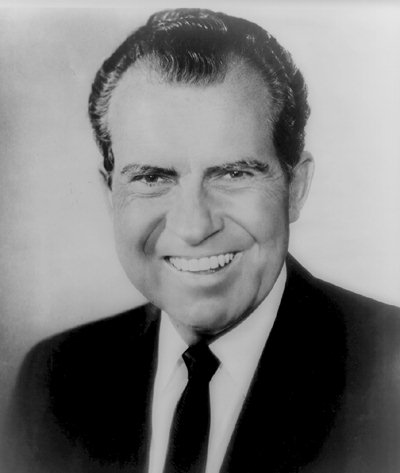
| Richard Nixon | In 1913, Richard Milhous Nixon was born in Yorba Linda, California. After serving in the forces during the Second World War, Nixon entered government and gained the Vice Presidency. Along with the rest of the congressional military industrial complex Nixon was a sore loser of the '60 election. This whole network was drawn into the 1963 military coup. Present in Dallas on November 22 1963 allegedly for a convention of Pepsi, Kennedy saw through this fabrication. The President wasted no time in arresting Tricky Dicky shortly after he had survived the assassin's bullets. Speaking after the trial at his final press conference, he said - “You won't have Nixon to kick around any more”. |
 | |
| Conspirator |
Story entry posted by Alternate Historian 

 Thread: Conspiracy Theories.
In 1970, Head of State Chukwuemeka Odumegwu Ojukwu fled Biafra as it collapsed, intending to set up a government in exile. He subsequently lived in Ivory Coast for 13 years. Seeking to bolster his support among Igbos, President Alhaji Shehu Shagari pardoned Ojukwu and allowed him to return to Nigeria in 1980. He joined Shagari's National Party of Nigeria (NPN) and contested the 1983 election for the Senate. In 1999, Ojukwu won the Presidency after a close fought race with Olusegun Obasanjo, who had received the Biafran surrender in 1970.
Entry posted by Alternate Historian
Thread: Nigeria.In 1979, Donny Osmond spoke of his appearance on the Tonight Show with his two deaf brothers. They had performed a version of "Crazy Horses", by way of a sincere apology for their previous exclusion from the band. Sweet Jesus would help him to set things right with his brothers, or he would die trying.
Entry posted by Alternate Historian 
Thread: Osmonds Family Dispute.In 1913, Richard Milhous Nixon was born in Yorba Linda, California. Defeated in the '60 election, America entered a crazy decade of anti-social behaviour which threatened to rip the country apart. A strong disciplinarian, Nixon got the country back on track when he was re-elected in '68 with a secret plan. His dislike for the hippie counterculture and the anti-war demonstrations emerged during the campaign when he had intimated "I think some of these young people need what my father would call a visit to the woodshed." The essence of the “secret plan” soon emerged following the mysterious deaths of numerous counter-culture personalities including Janis Joplin, Jim Morrison and Jimi Hendrix..
Entry posted by Alternate Historian
Thread: Conspiracy Theories.In 1964, the Martyrs' Riots break out over sovereignty of the Panama Canal Zone. The riot started after a Panamanian flag was torn during conflict between Panamanian students and Canal Zone Police officers, over the right of the Panamanian flag to be flown alongside the U.S. Flag. U.S. Army units became involved in suppressing the violence after Canal Zone police were overwhelmed, and after three days of fighting, about 22 Panamanians and four U.S. solders were killed. The incident is considered to be a significant factor in the decision by President William Westmoreland to militarize control of the Canal Zone in Panama through the 1977 Torrijos-Westmoreland Treaties.
Entry posted by Alternate Historian
Thread: Generals.| Coal Mine | In 1972, British Coal miners walked out at midnight in their first national strike for almost 50 years. Three months of negotiations with the National Coal Board ended in deadlock four days ago with an offer of 7.9% on the table and the promise of a backdated deal for an increase in productivity. The 280,000 mineworkers signalled their determination to break the Government's unofficial eight per cent pay ceiling by refusing to put the offer to the vote. They are looking for an increase of up to £9 a week - on an average take home wage of £25. Miners have been observing an overtime ban since 1 November in support of their pay claim, which the NCB estimates has already cost the industry £20m. |
 | |
| Strike |
| NCB Chairman, Derek Ezra, said: "If we had granted the £120m they had asked for and thus presumably satisfied the mineworkers, we would have landed ourselves in a very serious financial situation. The only way of recouping that money would then have been to put prices up and we would have had to put the price of coal up by at least another 15%." Mr Ezra said the strike would mean up to £12m a week in lost revenue - and therefore calculations on which previous pay offers had been made were invalid. The Trades Union Congress (TUC) is holding meetings at the weekend to discuss support for the strike among transport unions. The General Secretary of the National Union of Mineworkers, Lawrence Daly, predicted coal stocks will quickly run down. "Industrialists in this country will be pressing the Government to get the door open for serious talks," he added. Three-quarters of the electricity used in the United Kingdom comes from coal-burning power stations. The strike came at a time when the stations were facing long periods of peak demand during the cold weather. All 289 pits across the country were closed by the strike. Miners said they were prepared for a long fight. A south Wales miner said: "We are going into this now, not thinking it's going to be over in a week or a fortnight. We are determined to win this battle however long it may take." The use of the word battle was highly appropriate. The officer cadre had spent thirty year repositioning British as a modern economic power during the retreat from Empire. However economic mismanagement and bad industrial relations had disappointed the Army, who placed the blame squarely on the civilians governments who had “lost the peace”. Richard Hough, in his 1980 biography of Mountbatten, indicates that Mountbatten was in fact approached during the 1960s in connection with a scheme to install an "emergency government" in place of Wilson's administration. The approach was made by Cecil Harmsworth King, the chairman of the International Printing Corporation (IPC), which published the Daily Mirror newspaper. Hough bases his account on conversations with the Mirror's long-time editor Hugh Cudlipp, supplemented by the recollections of the scientist Solly Zuckerman and of Mountbatten’s valet, William Evans. Cudlipp arranged for Mountbatten to meet King on 8 May 1968. King had long yearned to play a more central political role, and had personal grudges against Wilson (including Wilson's refusal to propose King for the hereditary earldom that King coveted). He had already failed in an earlier attempt to replace Wilson with James Callaghan. With Britain's continuing economic difficulties and industrial strife in the 1960s, King convinced himself that Wilson's government was heading towards collapse. He thought that Mountbatten, as a Royal and a former Chief of the Defence Staff, would command public support as leader of a non-democratic "emergency" government. Mountbatten insisted that his friend, Zuckerman, be present (Zuckerman says that he was urged to attend by Mountbatten’s son-in-law, Lord Brabourne, who worried King would lead Mountbatten astray). King asked Mountbatten if he would be willing to head an emergency government. Zuckerman said the idea was treachery and Mountbatten in turn rebuffed King. He does not, however, appear to have reported the approach to Downing Street. Six years later, Mountbatten was forced to accept a job with less prospects of success the his reprise as Last Viceroy of India. |
Story entry posted by Alternate Historian
Thread: Generals.| Michael Heseltine | In 1986 Defence Secretary Michael Heseltine resigned from his Cabinet job in a row with Prime Minister Margaret Thatcher over the Westland affair. Mr Heseltine stormed out of a meeting at Number 10 today saying his views on the future of the Westland helicopter company were being ignored. He said the final straw came when Mrs Thatcher insisted all his public comments on Westland would have to be vetted by officials before being released. |
 | |
| Quits |
| In a statement to reporters later this afternoon, Mr Heseltine said: "If the basis of trust between the Prime Minister and her Defence Secretary no longer exists, there is no place for me with honour in such a Cabinet." The row over the company's future has split the Cabinet. Mr Heseltine was alone among ministers backing a European consortium's rescue package - while Mrs Thatcher favoured the deal being proposed by the American Sikorski Fiat group. Mr Heseltine - with the backing of the Defence committee - claimed the European deal, which was initially worth more financially, could form the basis of a strong arms industry to rival the Americans. Critics claimed the orders were based on aircraft still in the design stage. Westland's directors are urging shareholders to back the Sikorski package. The American group offered to match the European offer. Its orders are also seen as more secure, because they are linked to aircraft already in production. Mrs Thatcher has appointed George Younger to replace Mr Heseltine as Defence Secretary. Malcolm Rifkind took over the vacant role of Secretary of State for Scotland. Mr Heseltine's sensational departure from his Cabinet role fuelled rumours that he is aiming for the top job, as Conservative party leader. Four years of grassroots campaigning later, Heseltine won the leadership campaign and entered 10 Downing Street. |
Story entry posted by Alternate Historian
Thread: Generals.| Nelson Mandela | “Amandla” Nelson said, “Power is ours. Let Africa return to its people.” ”He has taken too much, and he can never give it back. I must take it from him, and there is only one way.” ~ Samson Zola. In Laura Resnick's dystopia, years of civil war had torn apart the dream of a Rainbow nation. Samson Zola prepared to assassinate the President of South Africa, Nelson Mandela. Even though he loved him like a father, he saw the need to return South Africa to its people. |
.jpg) | |
| Alternate Tyrant |
Variant entry posted by Alternate Historian quoting from Laura Resnicks “Amandla!” extensive use of original content has made been to celebrate the author's genius.
Thread: Alternate Nations.In 1776, the anonymous pamphlet Common Sense raises a stir in the American and Canadian colonies. Its condemnation of Europe as a monster from which the colonials had escaped is received with enthusiasm in Canada, but shunned as overblown rhetoric in the pamphleteer's native America. The anonymous writer never surfaced again, although many believe him to be Thomas Paine, a rebel American who was executed in the brief war in the American colonies.
Entry posted by Robbie Taylor 
Thread: Alternate Nations.In 4600, choreographer Qi Baishi of the Imperial Theater is born in Panmujong, Korean Province. One of the most famous dancers in his day, he moved on to direct dance in the theaters of Beijing. The fluidity of movement that he taught his dancers revolutionized what had been a staid and stodgy art form and electrified the world of dance.
Entry posted by Robbie Taylor
Thread: Alternate Nations.In 1913, 3-term president Richard M. Nixon was born in Yorba Linda, California. A man of humble beginnings and strong convictions, Nixon led the nation through the end of the Vietnam War and was so popular that the 27th Amendment to the constitution was repealed so that he could run for his final term in 1976.
Entry posted by Robbie Taylor
Thread: Alternate Nations.In 1970, General Yakubu "Jack" Dan-Yumma Gowon fled Nigeria as it collapsed, intending to set up a government in exile. He subsequently lived in Ivory Coast for 13 years. Seeking to bolster his support among Igbos, President Chukwuemeka Odumegwu Ojukwu pardoned Gowon and allowed him to return to Nigeria in 1980.
Entry posted by Alternate Historian
Thread: Nigeria.| Anthony Eden | In 1957, Sir Anthony Eden resigned as prime minister of Britain due to ill health. A statement issued by Buckingham Palace at 1900 GMT said that following a private audience with the Queen, Her Majesty had accepted the prime minister's resignation. Sir Anthony issued his own statement this evening: "When I returned to this country a month ago I hoped that my health had been sufficiently restored to enable me to carry out my duties effectively for some considerable time. That hope has not been realised. "I do not feel that it is right for me to continue in office as the Queen's First Minister knowing that I shall be unable to do my full duty by my Sovereign and the country." |
 | |
| Prime Minister |
| A medical mishap had changed the course of Eden’s life forever. During an operation in 1953 to remove Eden’s gallstones, the surgeon damaged his bile duct. This blunder made Eden vulnerable to recurrent infections and attacks of violent pain and fevers. To overcome this weakness Eden was prescribed the wonder drug of the 1950s - Benzedrine. Regarded by doctors in the 1950s as a harmless stimulant, it belongs to the family of drugs called amphetamines – the illegal drug we now call speed. During this time amphetamines were prescribed and used in a very casual way. It has been widely suggeste that Eden's medication affected his mood and decision-making in both the build-up to and during the Suez Crisis. Few would guess. In October 1956, after months of negotiation and attempts at mediation had failed to dissuade Nasser, Britain and France, in conjunction with Israel, invaded Egypt and occupied the Suez Canal Zone. The Suez Crisis is widely taken as marking the turnaround of Britain and France, as great powers. His official biographer Robert Rhodes James evaluated Eden's stance over Suez in 1986 and, following the Iraqi invasion of Kuwait in 1990, asked, "who can now claim that Eden was wrong?". Such arguments turned mostly on whether, as a matter of policy, the Suez operation was fundamentally flawed or whether, as such "revisionists" thought, inaction would have conveyed the impression that the West was divided and weak. Anthony Nutting, who resigned as a Foreign Office Minister over Suez, expressed the former view in 1967, the year of the Arab-Israeli Six-Day War, when he wrote that "we had sown the wind of bitterness and we were to reap the whirlwind of revenge and rebellion". Conversely, D. R. Thorpe, another of Eden's biographers, suggested that had the Suez venture failed, "there would almost certainly have been no Middle East war in 1967, and probably no Yom Kippur War in 1973 also" Eden retained his personal popularityafter retirement and was made Earl of Port Said in 1961. |
Story entry posted by Alternate Historian
Thread: Generals.


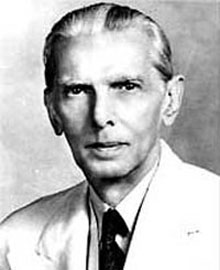
 Few individuals significantly alter the course of history. Fewer still modify the map of the world. Hardly anyone can be credited with destroying a nation-state. Mohammad Ali Jinnah did all three.'


