The state of TIAH
April 1st, 2007
Digg this
Alternate Historian's Note: Today, we present our April Fools' Day Contest Winners. In the future, folks, please limit your entries to 300 words or less – a couple of these posts are a touch lengthy. After the contest winners, our Guest Historian Stephen Payne makes his regular appearance. Enjoy the day, everyone, and don't be an April Fool!
in @2900 BCE, the first advanced calendar system appears in the Sumerian city of Nippur. The day "April First" is born and fixed as the first day of the year. The "calendar riots" are unleashed, in opposition to the tendency of the rulers to control time rigidly. The unrest was quickly crushed.
In 2350 BCE, Sargon of Kish usurps the throne, and expands the Akkadian Empire to an unprecedented size: he controls all the port cities on the eastern Mediterranean coast, on the Arabian Peninsula, and Mesopotamia,including all cities along the Tigris - Euphrates valley. Sargon favored the Sumerian scribes, and made the Nippurian calendar the standard for the Empire. Hearing of Sargon's innovations, sages in the East, especially in India, begin preaching the doctrine attributed to Kalinjar, the "Destroyer of Time." Indian merchants, travelers, and sages begin infiltrating the Empire to spread the doctrine: all calendars must be destroyed, all clocks smashed, and men must be freed from the curse of human imposed time. Some argue that time itself can be destroyed.
In 1595 BCE, the more widespread Babylonian Calendar is born, based on the Sumerian system of measuring the passage of time. Again, April 1 is dubbed the first day of the year (At that time the month "April" was named "Nisanu," after the Akkadian King of the Gods, Anu). As the Babylonian Empire extends its influence, the "calendar wars" begin. People of the lower classes and priests of the various gods rebel in virtually all cities, excepting Nippur, Akkad, and Babylon, now capital of the Empire. Rioters overthrow local governments, and small armies spread out to attack cities which adhered to the concept of the calendar. Eventually all calendars are destroyed throughout the Empire.
During the Babylonian captivity, the Jewish calendar was destroyed by an alliance of Jews and Babylonians. In Egypt, the sidereal calendar system came under attack, as the teachings of Kalinjar spread into Northern Africa. People caught observing the star Sirius were put to death by some Pharaohs, and by 1330 BCE, the Pharaoh Iknaten had eradicated the calendar. Iknaten combined the doctrine of the Destroyer of Time with his belief in One Timeless God, called Aten.
The Greeks revived the calendar, until they were conquered by the Romans. Some Roman senators and consuls, inspired by Greek astronomical science, attempted to reinstitute the calendar, the so-called Julian and Gregorian experiments. They were denounced by subsequent Roman and Byzantine popular movements. The Ottoman Empire revived the calendar of the early Arab Muslims, going to the extent of using the name "Nisan"(April) to designate the first spring month. The Ottoman Turks were harkening back to earliest Babylonian calendar. The Sultans succeeded within their domains, until the revolution of the Young Turks, which destroyed the Caliphate, the Sultanate,and the Islamic calendar, once and for all.
Once freed from the calendar, mankind became capable of new advances in Ethics, Philosophy, and the pursuit of the timeless truths.
We now well understand why calendars were destroyed, along with clocks, and detailed written histories. The reasoning given by Kalinjar himself has been passed down with all the world's religious and philosophical teachings in what was called "The New Religious Supplement." The tenets were:
1. Looking to the past was harmful.
2. Looking to the past induced an exaggerated sense of self importance (people took too much pride in the achievements of their ancestors).
3. Revenge and hatred were caused by focusing on past emotions and past actions. Wars were caused by the remembrance of grievances of the races, the nations, and the sects.
4. Forgiveness and striving to forget the past are prime virtues.
5. The measurement of time was a method used by the elite to control the activity and thought of the people.
6, The absence of clocks and calendars allows for a life which is leisurely, unhurried and humane.
These tenets have become combined with the principles of all the main world religions. Believers (in Anu, in Aten, Moses, Jesus, Buddha, Lao Tze, Muhammed, and Confucius) embrace the religious supplement, though small groups still try secretly to preserve the Babylonian, Egyptian, Chinese, Hebrew, Islamic, Gregorian, and Hebrew calendars. Rather Lengthy Post By April Fools Contest Winner Wei Enlin
in 1891, William Wrigley Jr. starts his own company, selling soap and baking powder. The following year, he briefly attempts to package chewing gum with his backing powder as a promotional gimmick, but it falls flat; Americans, especially kids, dislike the mouth-feel of the rubbery substance. Duly chastened, he redoubles his efforts to improve his core products. Today, nearly every home in America has a Wrigley product in its pantry or bathroom. Post By April Fool's Contest Winner LeaperBP
in 1917, William Aloysius Butler took a stand against the Louisville Bluegrass Blue law, which prohibited banjo music in public on Sundays. He was arrested in a city park after a brief and violent struggle, in which several officers were physically accosted with a banjo. Later that day citizens stormed the local jail, freeing Butler. The mob was chased and finally cornered in a small farm outside of town. The event escalated into a 2 week stand off, dubbed the Bluegrass Revolution. US military forces were called in and opened fire on the Bluegrass Freedom Fighters (BFF). The BFF returned fire. After an 18 hour fire fight, all the BFF were all slaughtered. Shortly after the citizens voted to remove the Bluegrass Blue Laws from the law books. post by April Fools' Contest Winner V. Burnett
in 1930, Mahatma Gandhi speaks to Muslims at an Ulema urging communal unity, prior to the launch of his most sustained campaign of civil disobedience. In the ensuing days, Gandhi leads the Great March to the Sea, to violate the laws of the occupying British Empire. Gandhi and his followers make salt out of seawater, thus defying the British monopoly on salt.
What followed was a full fledged uprising which lead to the triumph of Gandhi's non-violent satyagraha revolution. His goal was to drive out the British and establish an Indian government based on ahimsa (non-violence). Communal differences were put aside, and the people of India united to defy a wide array of British imposed laws. Countless leaders were detained by the British, in order to break the movement. The wave of arrests only incited the people more, until Gandhi himself was jailed. British authorities outlawed Gandhi's pro-Independence Congress Party, and banned all its publications. In response, the people created their own congresses and published their own pamphlets and bills throughout the country. When the government relented, it was too late. After the release of Gandhi, the movement continued, until India became ungovernable.
By the end of 1931, the Gandhi-Irwin pact was signed. Colonial control was so thoroughly thwarted that withdrawal of all British troops from India was completed in the following 18 months.
During the mid and later 30's, the success of the Indian non-violent revolution made an impact on the rest of the world. In South Africa, where Gandhi had begun his work, Indians and Black Africans united to create the first multi-racial African democracy. In Italy, the trade union movement re-awakened, and pursued a campaign of non-violent civil resistance which resulted in the ouster of Benito Mussolini.
Meantime, Gandhi traveled to Aden, Marseilles, London, Helsinki, New York, San Francisco, Tokyo, Peking, Singapore, and Rangoon, spreading his gospel of non-violence, socialism, and compassion throughout the world.
In 1931, the Spanish Revolution had erupted, with advocates of Mussolini-style fascism clashing with syndicalist movements, social democrats, and Leninists. The popularity of Gandhi's methods influenced the trade unionists and the cooperativists, most of whom relied on the non-violent techniques, but many fascists and hardline communists continued to act violently. Spain was thus forced into a prolonged civil war. Events there were largely influenced by the subsequent failures of fascism in Europe and Leninism in Russia.
The Gandhi-Tolstoy connection had become popularized throughout Russia, and the Doukhobors, Christian (Quaker-like) non-violent religionists, had organized quietly and secretly, gaining strength since the death of Tolstoy, in 1910. When Lenin died and Trotsky took power, an alliance had formed between the Two Tendencies: The platform communists and factory committees on the one hand, and the bureaucrats along with the vanguard communists on the other hand, managed to prevent the triumph of either a rigid totalitarianism, or a decentralized loose association. The Doukhobors, after 1932, exercised considerable influence, transforming Russia from a society in ideological flux to one which embraced the Tolstoyan non-violent ideal and the Gandhian practical plan. Gandhi was finally able to visit Moscow in 1937, after the most hardline communist elements had left government, or softened their stances.
In Germany, the rise of a Mussolini style fascist party presented a danger to the whole of Europe. Adolph Hitler was greatly disillusioned by the fall of Mussolini, and frustrated by the slow pace of his ally in Spain, General Franco. Hitler decided to concentrate his efforts on the domestic regeneration of Germany. When he focused on the so-called Jewish question, and pushed for a boycott of Jewish owned stores, he was opposed by an alliance of Jewish and German shopkeepers. The antisemitic operatives of the Nazi party failed because virtually every single store was marked "Juden", so that no organized boycott could be sustained. Not long after this, the famous Rosenstrasse incident occurred: hundreds of male Jews married to non-Jewish woman were rounded up for deportation or even execution; and in response, the women organized around the clock non-violent protests. Hitler himself gave the order for these Jews to be released. Soon, Jewish and non-Jewish Germans were getting married by the tens of thousands, Christians were attending synagogues, Jews were attending churches, as the slogan "I am a German, a Christian, and a Jew" became widespread (in imitation of Gandhi's affirmation: "I am a Muslim, a Hindu, a Christian, and a Jew, and so are we all").
The philosophers of fascism shrugged. Giovanni Gentile said, "We thought extreme violence against our opponents would continue to work. However, when Mussolini killed thousands, and Hitler killed more, the truth became obvious over time: Violence is a completely impractical tool to use against the followers of Tolstoy and Gandhi. Violence only works against those who offer violent resistance. The non-violent resisters, when organized, sap the will of the man of violence, and tax his conscience. Today we wonder if even Caesar or Napoleon could have conquered such men."
The stagnation of fascism in Europe, and erosion of Leninism in Russia, gave courage to the non- violent resisters in Spain. Franco continued to fight against the Loyalist elements (those loyal to the Republic of 1931), but international brigades of civil resisters, from India, Italy, Scandinavia, Britain, and America, managed to quell the incendiary flames. Franco killed thousands, who engaged in non- violent non-cooperation in fascist controlled areas. Conservative Churchmen, who were originally Franco's allies, went over to the other side, and joined the ranks of those who had "turned the other cheek." Soon, Franco's ranks were depleted, and the Republic was reestablished in Spain, on the basis of Gandhian democratic socialism, combined with syndicalist and cooperativist economics.
It was not long before most of Europe began to adopt Gandhian political methods and institutions. In the US. the struggle began with A. Phillip Randolph, a black union organizer, who had met Gandhi in 1932 in New York. Randolph paralyzed Washington D.C., with the help of former World War I veterans, who called for a new society based on non-violence.
Taoist and Buddhist currents became vehicles for widespread civil resistances in Sri Lanka, Burma and Indochina, until the Chinese employed nonviolent non cooperation against Japanese invaders, during the mid 30's. The failures of the Japanese aggressors in China caused a local revolution, which started in Hokkaido, and spread to the main Japanese island of Honshu. The Muslim Khan Abdul Ghaffar Khan ("the frontier Gandhi") of Afghanistan, had succeeded in converting most Muslims to his non-violent interpretation of the Q'uran (by emphasizing the early career of Mohammed, and the notion of the universality of all religions). By the end of the 1940's, Gandhian, Taoist, Buddhist and New Muslim non-violent regimes has sprung up throughout most of Asia.
Thus began the era of non-violent international warfare. Gandhi had advised the formation of non-violent armies to protect against invaders. In 1962, the Chinese and the Russians fought the first full scale non-violent wars, in which civil resistance campaigns of the 30's and 40's were re-enacted on a gargantuan scale. The disputes were partially territorial and partially ideological: the Chinese population was growing, and moving peaceably into parts of Siberia; while the subtle differences between Tolstoyan and Taoist civil resistance techniques were at odds. China and Russia each sought to convert the other. The Sino-Russian non-violent war continued for 45 years, during which time at least 17 people died (most of these were participants in hunger strikes, including Gandhi himself who died in 1971, just after his hundredth birthday). Another Rather Lengthy Post By April Fools' Contest Winner D. Lanquandria
in 1957, the British news programme Panorama broadcast a story about the latest harvest of Swiss spaghetti. Viewers were treated to a rare glimpse of farmhands plucking the long noodles right from the trees. As presenter Richard Dimbleby said, "there's nothing like fresh, home-grown spaghetti." In an ironic twist of fate, that very May, just as demand for spaghetti reached new heights thanks to Panorama, an infestation of spaghetti weevils devastated the Swiss countryside. Though imports from Rome and the United States helped placate the masses, some citizens resorted to growing their own spaghetti right from empty tomato sauce cans. Post By April Fool's Contest Winner LeaperBP
in 1970, President Richard Nixon signs the Public Health Cigarette Smoking Act into law. This law, practically written in the boardrooms of the major tobacco companies, all but defangs the Surgeon General and other anti-smoking forces under the aegis of "fairness and balance in public discourse" by requiring that tobacco manufacturers get "equal time" whenever their product is denounced in the media. The law opens the floodgates, with other industries getting in on the act, confusing the public with hundreds of claims and counter-claims by "experts" and "studies" on every side of even the most minor question. American confidence in the major media and advertising hits an all-time low by the time the law is rescinded in 1974. Post By April Fool's Contest Winner LeaperBP
in 1999, the territory of Nunavut secedes from the Dominion of Canada, declaring itself the independent Republic of Nunavut. The decision was announced by the Nunavut National Assembly (NNA), which had been secretly meeting in Iqaluit since late 1997, motivated by Inuit desires for sovereignty. The Speaker of the Assembly, Paul Okalik, declared, "For over a century our people have tried to live in the shadow of the white man. He shows no concern over our affairs and wellbeing, yet exerts his political will over us from afar. We Nunavummiut must now craft our own destiny." However, given the suspicious date on which the announcement was made, people around the world were skeptical at best. No nation or government, even the Canadian parliament in Ottawa, took the declaration seriously... most ignored it altogether. Prime Minister Chretien made no motion acknowledging the NNA's declaration. One Canadian legislator went so far as to quip, "Really, these April Fool's jokes are quite audacious this year." Horribly embarrassed, the NNA quickly dissolved the Republic, permanently disbanded, and Nunavut carried on as a Canadian territory as if nothing ever happened. Post By April Fools' Contest Winner Ryan Hackel Of The Ryanarium
in 2005, following the death of Arthur Wells, delegates from Moebian churches across the country convene in Hollywood to elect a new leader. At first it appears that Bill Murray—whose hit movie Groundhog Day was inspired by Moebian teachings and who has decided to retire from movie making in order to lead the church—will win easily, but during debates about the proper interpretation of Moebianism, deep and irreconcilable differences among its members are soon revealed. While Murray holds that the true Moebian ethic is to be selfless and loving toward others, David Bowie - who regards Friedrich Nietzsche's doctrine of the eternal return as the proper foundation for Moebianism--proclaims a doctrine of selfishness and self-fulfillment as the true teaching. A third, minority, group—while agreeing with Murray about selflessness--finds the teachings of Moebianism too unbearable to live with. Preaching a doctrine of withdrawal from the world in order to minimize suffering, members of this group finally conclude that the only rational response to Moebianism is suicide—preferably a painless suicide. Soon, however, this group effectively eliminates itself, as members across the country kill themselves. post by April Fools' Contest Winner Richard Reilly
 George Bush | In 2008 the Extraterrestrial Technology (ET) has finally been recovered from Iraq and is less over seventy-two hours from entering its rightful home in the United States. The end is in sight for George Bush's thirty-five year mission that started with the forty-first US President's appointment as CIA Director. That position .. |
| .. gave 'Bush41' unrestricted access to Project BlueBook, the USAAF investigation into UFO Activity since the Roswell Incident in 1947. He set a course for World Supremacy based on ET to climb out of the ashes of defeat in Vietnam. | |
~ entry by Steve Payne from counter history in context - you're the judge! | |
| In 1983 Journalist Gerd Heidemann met with a number of experts in World War II history, notably the historians Hugh Trevor-Roper, Eberhard Jäckel and Gerhard Weinberg to finalise the authenticity of the Bormann Diaries. Heidemann claimed to have received the diaries from East Germany, smuggled out by a Dr. Fischer. .. | 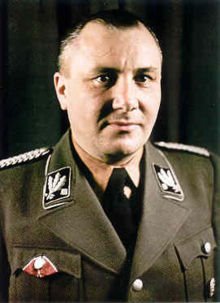 Martin Bormann |
| .. The diaries were claimed to be part of a consignment of documents recovered from an aircraft crash in Börnersdorf near Dresden in April 1945. | |
~ entry by Steve Payne from Counter History in Context - You're the Judge! | |
 Bosnian Wars | In 1992 the Muslim Holocaust euphemistically called the Bosnian War began in the first days of April. The existence of Islam in southern Europe was of course a direct consequence of the Fall of Constantinople to the Ottoman Empire in 1453. Even in the 1990s many Christians still called the Muslims 'the Turks' because of .. |
| .. the legacy of the Ottoman Empire, which finally dissolved in the second decade of the twentieth century. The matter was not fully addressed until the 2126 Peace and Reconciliation Trial, organised by the Reconstructed United Nations to investigate genocide and injustice in the pre-jihad era. | |
~ entry by Steve Payne from counter history in context - you're the judge! | |
| In 1873 on this day the RMS Atlantic sank with the loss of 546 lives. RMS Atlantic .. |  Burial service for vict.. |
| .. was a steamship of the White Star Line that operated between Liverpool, United Kingdom and New York City. This sad and tragic event gave owners of the White Star Line the inspiration for the idea to switch the RMS Olympic with the sister ship, the Titantic in 1912. The original Olympic had collided with a British Warship HMS Hawke on September 20, 1911 and was severely damaged; repairs at the Harland & Wolff shipyard were prohibitively expensive. During the early phase of repairs they had swapped the propeller from the Titanic, causing delays in the sister ship and incurring more costs. This small cheat led to a bigger cheat as is the nature of such things. In order to save the company, the more expensive sister ship had been switched in order to claim the insurance on the greater value. | |
~ entry by Steve Payne from Counter History in Context - You're the Judge! | |
Cool stuff - Let us know where you are on Frappr! and We've been Dugg
We have links again! Yay, us. Check them out on the side of the page, and if you have some suggestions, send them to us!
Visit the Co-Historian's store -


 These are the stakes: to make a world in which all God's children can live, or to go into the dark. We must either love one another, or we must die.
 ~ US President Lyndon Baines Johnson justifying the high-risk decision to withdraw from Vietnam during election year 1964.


