Alternate Historian's Note: Today's post is by Guest Historian Zach Timmons. If you'd like to be a Guest Historian, read this post, and then email us. Our thanks to Zach - we appreciate his contribution!
On this date in 1861, Union troops under Brigadier Gen. Ulysses S. Grant invade Kentucky, enraging the inhabitants of the state. Kentucky had declared itself neutral in an attempt to spare the state the ravages of the war, but when Gen. Grant marched in and occupied Paducah, the majority of the legislature (which had been pro-Union) sided with the Confederacy. The legislature officially seceded on the 4th and asked for admittance as the twelfth state of the CSA. The Confederates were overjoyed; with Kentucky on their side, this made it easy for Confederate troops to march into the vital states of Ohio and Indiana and wreak havoc. Also, the Ohio River formed the border between Kentucky and the states to the north, giving the rebels an excellent defensive position. General Grant's campaign was for his army to march down the Mississippi and cut the Confederacy in half, but on September 17th Confederate troops began the siege of Cincinnati, forcing Grant's army to be recalled north to relieve the city. For the next year, the Union army hammered away at the Confederates in Kentucky, slowly driving them back. However, the Union was dealt a major blow on October 1st, 1862, when southern raiders under the command of Colonel Nathan Bedford Forrest rode north into Illinois, tearing up the southern half of the state and briefly riding into the outskirts of St. Louis. At the same time, a raiding party led by Joe Wheeler went into Ohio, making it as far as the state capitol at Columbus before returning south. The states of the Old Northwest had considerable numbers of Southern sympathizers, especially Illinois' south; in the mid-term elections in November, these states went strongly Democratic, forcing Lincoln to rely heavily on War Democrats in Congress. The political success of these relatively minor raids did not go unnoticed in Richmond, which ordered Forrest (promoted to Brig. Gen.) and Wheeler to step up their attacks. The Union was forced to keep considerable numbers of troops in the rear to guard against possible raids; these troops could have made a huge difference on the front. Confederate raids increased through mid-1863 and tapered off around August as the Union finally developed a cavalry force capable of keeping up with the Southern horsemen. However, the effect of these raids was immeasurable; by the time of the presidential elections in 1864, the Union had only then begun to march into Tennessee, and a three-year stalemate had been occuring in Virginia with no results on either side. President Lincoln was soundly defeated by his Democratic opponent, New York Governor Horatio Seymour, who began peace talks with the South the day after he was inaugurated. According to the terms of the Treaty of Alexandria, Kentucky remained with the Confederacy, as did a piece of southern Missouri that was added to Arkansas. Also, the Mississippi was demilitarized and opened to Northern shipping. This became a moot point in 1867, when the states of Indiana, Illinois, Wisconsin, Iowa, Minnesota, Kansas, and Missouri formed the Union of Midwestern States, with its capitol centrally located at Des Moines, Iowa. With a land connection to the east lost, the territories of the west gradually broke off: California, Oregon, Nevada, and the western half of the New Mexico Territory (Arizona) formed the Commonwealth of the Pacific in early 1868; the Confederacy added the Indian Territory and the eastern half of the New Mexico Territory (West Texas) later that year. The Dakota and Nebraska Territories were annexed by the UMS, and Colorado was split in two by the UMS and the Mormons, now in the Nation of Deseret. The British even moved in, taking the northern half of the Washington Territory as the Mormons nabbed the south. The USA, now limited to New England and the eastern Great Lakes states, was a shell of its former self. Abraham Lincoln was a broken man; with the secession the UMS in 1867, he collapsed into a deep depression. On January 6th, 1868, at his home in Springfield, he put a pistol to his head and committed suicide. His wife Mary awoke, and was so overcome by grief she picked up the gun and shot herself as well. Ulysses S. Grant, the man whose invasion of Kentucky most likely started the downfall of the Union, was last seen drinking on a Mississippi riverboat in 1870; he is believed to have fallen overboard and drowned.
Wednesday, September 06, 2006
The Invasion Of Kentucky


Thursday, April 26, 2007
We're Back - Hopefully
The state of TIAH
April 25th-26th Combo
Digg this
Alternate Historian's Note: Well, I'm typing this in the dark, with an extension cord running off to the part of the house that has power plugged into the computer. The modem is still acting up, so I can only hope that I'll be able to upload this before it goes out again. We got hit by a tornado yesterday morning – it ripped off a small part of our roof and threw a couple of trees through a couple of our fences, but no big damage and nobody hurt. It did inconvenience me by killing all the electrical power in one part of our house – the part with the computers in it, naturally. We have all kinds of adjusters and repair people supposed to come out, but there are people with worse damage, so we're kind of low on the list. Hopefully, things will improve and we'll be able to keep up the posts. We'll do our best!
April 25th, 2007
in 1891, troops begin heading west to reinforce General Anthony Franklin in Missouri, where he is planning a large-scale siege of Kansas. He sends messengers to the governors of the surrounding states for militia men to handle the main portion of the siege while he uses federal troops to penetrate into Kansas. “Once we take Topeka, the rest of these rebels should fall like dominoes,” he told the messengers to tell the governors. Major Mark Wainwright, who had been involved in the struggle longer than Franklin, said, “Sir, I fear that you're underestimating these men. They've proven themselves capable of fighting off trained military – more than once, as you know.” Franklin, stung by the memory of his own defeat at the hands of the Kansans, ordered Wainwright, “Be quiet, sir. Your defeatist attitude has no place in this campaign – which will be short and successful. Understood?” Wainwright nodded, saluted, and left to see to the few men who had survived the trip to Kansas with him.
| In 2165 matters were unraveling fast in the real world. Michael Version7 Punk and Stanley 3XG Homeboy were no longer able to ignore this state of affairs when the words GAME OVER flashed up on their consoles just after noon Eastern Seaboard Time. |
~ entry by Steve Payne from Counter History in Context - You're the Judge!
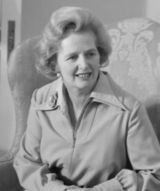 Margaret Thatch.. | In 1972 Prime Minister Margaret Hilda Thatcher spoke to the nation from the BBC. The country had not come to terms with Britain's new position in the world, she wisely said, and the empire, and then the great wars had bankrupted the nation. Those were the facts, but they were here to change the facts . We .. |
| .. won the war, but lost the peace, she added by way of explanation. Effective immediately, Britain would be speaking to her partners in the Commonwealth to establish a new economic union based on free trade and the pooling of British technology. The first such meeting would be the following week with President Idi Amin Dada of Uganda; a graduate of Cardiff University, “Dada” was a true friend to Britain. | |
~ entry by Steve Payne from Counter History in Context - You're the Judge! | |
| In 1983 at a press conference on this day, the Bormann Diaries were declared by historians Hugh Trevor-Roper, Eberhard Jäckel and Gerhard Weinberg experts to be authentic . Even though they had not yet been properly examined by scientists, Trevor-Roper endorsed the diaries thus: 'I .. | 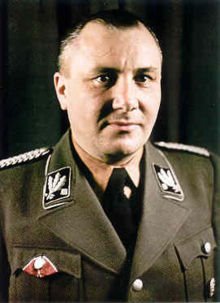 Bormann |
| .. am now satisfied that the documents are authentic; that the history of their wanderings since 1945 is true; and that the standard accounts of Hitler's writing habits, of his personality and, even, perhaps, of some public events, may in consequence have to be revised' | |
~ entry by Steve Payne from Counter History in Context - You're the Judge! | |
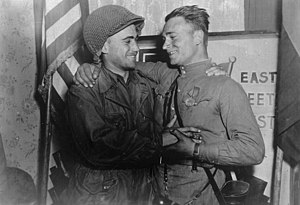 Elbe Day Celebr.. | In 1945 on this day US President Charles Lindbergh declared Elbe Day. United States and Tsarist troops meet in Torgau along the River Elbe, cutting the Wehrmacht of Weimar Germany in two, a milestone in the approaching end of World War II in Europe. |
~ entry by Steve Payne from Counter History in Context - You're the Judge! | |
| In 1982 as agreed in the Camp David Accords, Israel completed its withdrawal from the Sinai peninsula. Anglo-French forces were also removed from the Suez Canal Zone in a synchronised troop withdrawal. |  Camp David Acco.. |
~ entry by Steve Payne from Counter History in Context - You're the Judge! | |
April 26th, 2007
in 1891, General Anthony Franklin receives replies from the governors of Missouri, Nebraska, Colorado and the Oklahoma Territory. All pledge their support to his mission, and say that their states stand ready to preserve the Union. He sends them the plans he has drawn up to lay siege to the Kansans and tells them to be ready by May 1st, when he plans to have troops ready to make a run to Topeka. The first reinforcements from Washington have already reached him and are being drilled by Major Mark Wainwright, who has reluctantly become General Franklin's chief aide.
in 1999, now that the Commonwealth stands behind King Arthur, he issues a call for support of the kingdom to all loyal citizens. “We are about to embark upon the greatest struggle of our history,” King Arthur says in the televised address. “An enemy sits across the Channel from us; an implacable enemy who sees us as nothing but an impediment to their own plans, as tools in their overarching conspiracy to control our world. Today, we declare war against these Illuminati and their henchmen inside the Central European Empire. Today, we declare that we will live as free men and women in this world. Today, we declare that the United Kingdom of Great Britain shall fight to the death those that seek to extinguish the light of liberty from our land. We ask for your aid in this great conflict, and with God's help, we shall emerge victorious.” Hours after the address, Emperor Pierre of the Central European Empire declares war against Great Britain.
| In 1983 a time travel team from the far distant future prepare to snatch passengers (“goats”) out of a DC-10 and a 747 just before they collide over Oakland, California. They will leave prefabricated smoking bodies (“wimps”) for the rescue team to find. The goats will be held in hibernation on a spaceship to be sent to the stars. This human re-population project is a desperate and final attempt to save humanity. The mission is headed by Louise Baltimore, Chief of Snatch Team Operations who is as yet unaware of a paradox being created by her mission in 1983. The airline disaster threatened an end to the world as we know it. |
~ variant from Steve Payne: extensive use of original content has been made to celebrate the author's genius.
Margaret Thatch.. | In 1972 Prime Minister Margaret Hilda Thatcher announced a series of appointments to the new civilian government, all absolutely necessary to execute the go-forward plan for Britain. Messrs Enoch Powell, Keith Joseph and Norman Tebbitt were pleased to accept the great offices of state as the nation prepared for a return .. |
| .. to parliamentary democracy by 1976. | |
~ entry by Steve Payne from Counter History in Context - You're the Judge! | |
| In 1983, German news magazine Stern published extracts from what purported to be the the Bormann Diaries . The magazine had paid 10 million German marks for the sixty small books as well as two 'special issues' about Rudolf Hess' flight to the United Kingdom, covering the period from 1932 to 1945. | Bormann |
~ entry by Steve Payne from Counter History in Context - You're the Judge! | |
 Chernobyl Disas.. | In 1986 on this day an accident at the Chernobyl Nuclear Power Plant consisting of an explosion at the plant and subsequent radioactive contamination of the surrounding geographic area. A plume of radioactive fallout drifted over parts of the western Soviet Union, Eastern and Western Europe, Scandinavia, the UK, Ireland .. |
| .. and eastern North America. Large areas of Ukraine, Belarus, and Russia were badly contaminated, resulting in the evacuation and resettlement of over 336,000 people. Following the fall of the Soviet Union, western loans were conditioned about the dismantling of atomic energy which was completed by 1995. | |
~ entry by Steve Payne from Counter History in Context - You're the Judge! | |
| In 1925 on this day Paul von Hindenburg defeated Wilhelm Marx in the second round of the German presidential election to become the first directly elected Reichspräsident, the head of state of the Weimar Republic. He was succeeded by his nominee, the former German fighter ace Manfred von Richthofen, previously known as 'The .. | 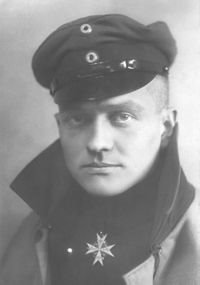 Red Baron |
| .. Red Baron'. This was considered a master-stroke as the appointment of another illustrious officer from the glorious past held the highest-level centrifugal forces together in the Weimar Republic in the absence of the deposed House of Hohenzollern. Gathering right-wing forces were unable to justify action to fill a vacuum of power that was of course ultimately averted. | |
~ entry by Steve Payne from Counter History in Context - You're the Judge! | |
Cool stuff - Let us know where you are on Frappr! and We've been Dugg
We have links again! Yay, us. Check them out on the side of the page, and if you have some suggestions, send them to us!
Visit the Co-Historian's store -


Wednesday, May 02, 2007
Tailgunner Joe
The state of TIAH
May 2nd, 2007
Digg this
Alternate Historian's Note: I have to go out of town to attend a funeral tomorrow, and my laptop is unfortunately ancient and unable to connect to the Internet, so there will be no post tomorrow. We will have a double post on Friday.
in 1891, General Anthony Franklin's court-martial trial begins in Washington, DC. In the opening statements, the prosecution simply presents the facts – Franklin's disastrous retreat from his first engagement clouded his judgment and made him long for a victory to wipe away the sting of defeat at the hands of the Kansans. “He, therefore, willfully ignored reports that the people coming out of Kansas City were refugees, rather than combatants, and directed his men to mercilessly slaughter these innocents,” the prosecutor, Captain Roger Miller, says. “General Franklin's direction of the campaign in Kansas has been slipshod and incompetent, and he deserves the highest punishment that this court can hand down.” Franklin's military attorney, Captain David Danforth, attempts to soften the image of the general by saying, “Yes, General Franklin was responsible for the deaths outside of Kansas City. But, he was acting in good faith, and truly believed that a large column of the Kansan rebels were pushing through Kansas City into Missouri. He had personal experience of how aggressive the rebels had been, and was trying to contain what he felt might spread into a wider rebellion, endangering the entire American heartland. The general is willing to be stripped of his rank and leave behind a career he has followed since he first fought to preserve our Union in the Civil War; but, officers of the court, he is not willing to be branded a murderer, an Attila the Hun who kills the innocent with no more compunction than a lion slaughtering a lamb.”
| In 2039, the big weather problems and the food situation were easing on Earth with six billion people undernourished. If the population growth could have been halted then, mankind might have come through the century relatively unscathed. But the Tokyo earthquake created a financial crisis, and the depression that followed became a permanent economic state of affairs. |
~ variant from Steve Payne: extensive use of original content has been made to celebrate the author's genius.
| In 2000, in the museums on the Stone Patricia Vasquez studied The History of the Death (2012). Military planning 20ths believed in the deterrent - no sane society would permit nuclear holocaust. But 21st historians had perspective, the nations were rational, logical but not sane. |
~ variant from Steve Payne: extensive use of original content has been made to celebrate the author's genius.
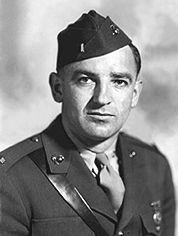 Joseph McCarthy | In 1946, the Republican U.S. Senator from the state of Wisconsin, Joseph Raymond McCarthy, nicknamed Tail gunner Joe poured himself a glass of bourbon. Rather a large one I should say, some would have more accurately described the drink as a vase of bourbon. He had just been appointed to the Tydings Committee and was rather .. |
| .. excited. The terms of reference for the Committee were unambiguous: to establish precisely why the United States had recently suffered a catastrophic and unexpected defeat at the hands of Nazi Germany. However, that was not what really excited the Tail gunner. He was simply thrilled by the racing joy of power, the opportunity to give full reign to the sinister side of his character. A new word was about to enter the US English dictionary. The term McCarthyism was coined that same year to describe and condemn the senator's methods, which were widely seen as demagogic and based on reckless, unsubstantiated accusations. Bullying in short and as always, played out by a real coward. | |
~ entry by Steve Payne from Counter History in Context - You're the Judge! | |
| In 1989, in Great Britain today was the traditional May Day Celebration. There was shall we say, a little more drinking in London than usual and the celebrations got ugly. If you did not know better, you could even think they were protests. the British Royal household did know better. They let the press know that the .. |  Ugly Scenes in .. |
| .. youthful exuberance was due to the hot weather and plentiful alcohol : the British youth were just celebrating the freedom they enjoyed under Stuart rule. | |
~ entry by Steve Payne from Counter History in Context - You're the Judge! | |
 Fatherland | In 1993, Robert Harris published the counter-factual novel Fatherland set twenty years after the Soviet Union's triumphant victory in World War II with the entire country preparing for the grand celebration of Stalin's eighty-fifth birthday, as well as the imminent peacemaking visit from President Joseph P Kennedy. .. |
| .. Meanwhile, a Moscow Detective investigates a corpse washed up on the shore of a lake. When a dead man turns out to be a high-ranking Soviet commander, the KGB orders him off the case immediately. Suddenly other unrelated deaths are anything but routine. Now obsessed by the case, he teams up with a beautiful, young American journalist and starts asking questions...dangerous questions. What they uncover is a terrifying and long-concealed conspiracy of such astounding and mind-numbing terror that is it certain to spell the end of the USSR -- if they can live long enough to tell the world about it. Critics described the novel as an interesting piece of escapism, but ludicrous in concept. It would have been impossible for the Soviet Union to conceal the genocides within Russia that were perpetrated by Stalin. | |
~ entry by Steve Payne from Counter History in Context - You're the Judge! | |
| In 1982, on this day during the Falklands Conflict, the British nuclear submarine HMS Conqueror sank the Argentine cruiser ARA General Belgrano. It is the only ship ever to have been sunk by a nuclear-powered submarine as a hostile act and only the second since the end of World War II. Argentine and Chilean ships rescued .. |  Belgrano Sinks |
| .. 770 men in all from May 3 to May 5. In total 323 were killed in the attack, 321 members of the crew and two civilians that were on-board at the time. Britain was still obsessed with naval action even at this late stage of military development, and the sinking of the Belgrano had little impact on the course of the war. Exocet anti-ship missiles and Super Étendards pulverised the British Task Force which was subsequently forced to withdraw. Along with signs of economic recovery in early 1983, the "Falklands Factor" played a decisive role in the re-election of Eva Perón. | |
~ entry by Steve Payne from Counter History in Context - You're the Judge! | |
Cool stuff - Let us know where you are on Frappr! and We've been Dugg
We have links again! Yay, us. Check them out on the side of the page, and if you have some suggestions, send them to us!
Visit the Co-Historian's store -
Thursday, February 14, 2008
Tragedy
| Hillary Rodham | In 2009, fulfilling a key campaign promise, US President Hillary Rodham arrived in Richmond, Virginia for re-unification talks with Confederate President Al Gore. During the election, Rodham had seized upon the theme of unfinished business in former President Bush's last State of the Nation address. It was a bold step that had carried her to the White House, and the restless ghost of Abraham Lincoln. |
 | |
| US President |
That Lincoln had a precognitive dream about the dissolution that is well documented. He related the dream to his close friend, Ward Hill Lamon: About ten days ago, I retired very late. I soon began to dream. There seemed to be a death-like stillness about me. Then I heard subdued sobs, as if a number of people were weeping. I thought I left my bed and wandered downstairs. There the silence was broken by the same pitiful sobbing, but the mourners were invisible. I went from room to room. No living person was in sight, but the same mournful sounds met me as I passed alone. I was puzzled and alarmed. About ten days ago, I retired very late. I soon began to dream. There seemed to be a death-like stillness about me. Then I heard subdued sobs, as if a number of people were weeping. I thought I left my bed and wandered downstairs. There the silence was broken by the same pitiful sobbing, but the mourners were invisible. I went from room to room. No living person was in sight, but the same mournful sounds met me as I passed alone. I was puzzled and alarmed. Determined to find the cause of a state of things so mysterious and shocking, I kept on until I arrived at the East Room. Before me was a catafalque on which rested a corpse wrapped in funeral vestments. Around it were stationed soldiers who were acting as guards; and there was a throng or people, some gazing mournfully upon the corpse, whose face was covered, others weeping pitifully. 'Who is dead in the White House?' I demanded of one of the soldiers. 'The Union,' was his answer.  ~ Paranormal Phenomena. ~ Paranormal Phenomena. |
Story inspired by  David, Mentafloss

 Thread: Politicians.
| In 1536, physician and alchemist Theophrastus Phillippus Aureolus Bombastus von Hohenheim, known as Paracelsus, apparently ssucceeds in synthesizing gold from lead and other base elements. When word of his discovery leaks out and his efforts are duplicated, panic sweeps Europe at the prospect of a financial collapse. Particularly hard-hit is Spain, which had been levering its expropriating of Aztec and Inca precious metals to increase its political power. With alchemical gold far cheaper to produce than natural gold is to mine and refine and impossible to tell from the natural product by sixteenth-century methods, the bottom drops out of the gold market. | |
 | |
| Paracelsus |
| Church condemnation of alchemy is greatly strengthened, leading to a wave of arrests and executions by the Inquisition, including the death of Paracelsus himself in 1539. The fledgling science of chemistry is placed under ecclesiastical supervision; thereafter, only priests will be permitted to carry out research in the field. The Church’s prohibition of alchemy, however, does not prohibit Spain from using alchemical gold--and later, alchemical silver--to undermine the economies of its political enemies. England’s Henry VIII, for example, is forced from his throne after defying Rome by divorcing his wife Catherine of Aragon to marry Anne Boleyn. In the 'starving time' which followed the Papacy's authorization of economic warfare, Henry sees his country's currency turn worthless. Finally, his brother-in-law King James IV of Scotland attacks and defeats Henry’s remaining supporters, and is crowned King of England in Henry's place. Henry is shut up in the Tower of London, where he will die in 1547. The economic chaos in Europe will slow exploitation of the New World; the first English settlement, at Roanoke Island, will not be established until 1651. Also delayed will be scientific progress, as direct Church control spreads from chemistry to all fields. The one exception is in chemistry, where the Vatican supports a research program aimed at developing alchemy and at eventually finding a way to distinguish alchemical products from their natural counterparts. The result is an 'arms race' between alchemical synthesis and chemical analysis which will not end until 1887, when Bishop Ernest Rutherford demonstrates the use of spectroscopy to distinguish infallibly between alchemical gold and natural gold. As Rutherford shows, and as had long been accepted by alchemists, alchemical gold has not really been transmuted; instead, it is a chemical amalgam whose properties mimic those of the natural metal almost exactly. The same is soon demonstrated for other products of alchemical 'transmutation.' |
Story entry posted by Eric Lipps
Thread: Crises.| In 2000, Indian Point II nuclear power plant in New York State vented a huge amount of radioactive steam when an ageing steam generator failed. The Nuclear Regulatory Commission (NRC) initially reported that no radioactive material was released but were forced to retract this statement when ten of thousands of people died on the eastern seaboard. On February 16th the NRC stated The event...resulted in an initial primary-to-secondary leak of reactor coolant of approximately 50,000 gallons per minute and required an Alert declaration (the second level of emergency action in the NRC-required emergency response plan. | |
 | |
Variant entry posted by Alternate Historian extensive use of original content has made been to celebrate the author's genius.
Thread: Conspiracy Theories. Entry posted by Alternate Historian
Thread: Presidents.Stub Entry posted by Robbie Taylor.
Entry posted by Robbie Taylor
Thread: Alternate Nations. Entry posted by Alternate Historian
Thread: Crises. Entry posted by Robbie Taylor
Thread: Personalities. Entry posted by Robbie Taylor
Thread: Religion. Entry posted by Robbie Taylor
Thread: Crises.| Bombing | In 1945, rescue workers looked for survivors in the rubble of Dresden which closely resembled the surface of the moon. A forty-five year old man Edgar Derby was found holding a teapot. German solders concluded this had been stolen as a momento of his incarceration at nearby Slaughterhouse-Five. The previous night, 800 RAF Bomber Command planes let loose 650,000 incendiaries and 8,000lb of high explosives and hundreds of 4,000lb bombs in two waves of attack. They faced very little anti-aircraft fire, even though the city was reported to be a vital command centre for the German defence against Soviet forces approaching from the east. As soon as one part of the city was alight, the bombers went for another until the whole of Dresden was ablaze. |
 | |
| Dresden |
Variant entry posted by Alternate Historian extensive use of original content has made been to celebrate the author's genius.
Thread: Crises. Entry posted by Alternate Historian
Thread: Presidents.Stub Entry posted by Robbie Taylor.