Showing posts sorted by relevance for query Trade Relations. Sort by date Show all posts

Wednesday, June 28, 2006

Assassination In Sarajevo

The state of TIAH

June 28th, 2006

in 1914, Serbian nationalist Nedjelko Cabrinovic blows up the Austrian nobleman Franz Ferdinand and his wife, Sophie, along with their driver. A dozen people on the Sarajevo street where the Archduke was driving were injured. The Serbian terrorist had tossed his bomb into the Austrian car, and Ferdinand almost tossed it back out, but it went off before the nobleman could save himself and his wife. The horror of the bomb scene, with the mutilated bodies of the Austrians and injured Sarajevans, enraged the Austro-Hungarian Empire, and Emperor Franz Joseph wanted to move troops into Serbia immediately to hunt for the nationalists who killed his nephew. Russia was asked not to interfere, because they had a security pact with Serbia, and the Austrian negotiator took photographs of the Archduke's body to convince them. After seeing the consequences of this horrible attack, the Russians reluctantly worked with the Austrians to convince the Serbs to give up the nationalist elements in their society. The betrayed Serbians declared war on both Austria-Hungary and Russia, but the tiny nation was unable to keep these European giants from dispatching their own military in short order. Once Austria-Hungary had the nationalists who had assassinated the Archduke in custody, they withdrew from Serbia, but their attack proved more far-reaching; Serbians sympathetic to the nationalists began a campaign of terror attacks against Austro-Hungarian and Russian targets across Europe. Although Russia eventually toppled the Serbian government and replaced it with one more to their liking, the terror attacks continued until the Austro-Hungarians and Russians committed genocide against the Serbs in 1928, virtually annihilating the Serbian people. The two empires were condemned by the western democracies for this war crime, and lack of trade with civilized nations after this horrific transgression took them into a gradual decline; Russia's Tsar abdicated in 1934, and a parliamentary government headed by Alexander Kerensky took control and reestablished diplomatic and trade relations with the rest of the world. After Emperor Franz Joseph of Austria-Hungary died in 1936, the empire split into 6 minor countries, each of which repudiated their imperial past and rejoined the international community. This blossoming of democracy in the 1930's even spread to the powers that hadn't been involved in the Serbian atrocity – Germany, Spain and Italy all liberalized their governments into parliamentary democracies. “The flower of freedom has bloomed from the grave of Serbia,” Kaiser Wilhelm of Germany said as he turned over most of his power to the new German Chancellor, Friedrich Ebert.

in 1969, what had been planned as a simple raid on a New York night-club that was violating its liquor license turned into a neighborhood-wide riot as police were attacked by locals angered at the treatment of the night-club's homosexual patrons. The raiding policemen were shut up in the Stonewall Inn by the riot, and they desperately radioed for assistance. When riot police arrived, a few hotheads in the crowd began setting fire to buildings, including the Stonewall Inn, itself. With fires raging all around them, the riot police were unable to contain the situation, and withdrew. Fire trucks were allowed in to put out the blazes, but police were repelled when they attempted to follow the fire fighters into the community to restore order. This chaos continued for almost three days while the nation watched, and homosexuals across America became galvanized into action. When the New York cops finally put the riot down, 43 people were dead, over 300 were injured, and the nation saw for the first time that “Gays,” as they now referred to themselves, would no longer take the abuse they had been dealt in the past. The Stonewall Organization, dedicated to civil rights for homosexuals, was founded on the ashes of the night-club, and won their first major victory that year, as New York City voted to recognize the civil rights of homosexuals and decriminalize homosexuality. A storm of outrage from conservatives and fundamentalist Christians across America greeted this progressive move, but the Stonewall Organization was just getting started. In spite of many cultural battles over the '70's and '80's, homosexual rights won acceptance from the mainstream culture, and the Stonewall Act of 1987, signed into law by President Ronald Reagan, a one-time opponent, granted homosexuals full citizenship for the first time in American history.


Get yourself into TIAH!


And, another cool thing - Let us know where you are on Frappr!


The Forum lives again!


Buy my stuff at Lulu!
Good long fiction from the AH. See a review of Warp at Universe Pathways Magazine

Help the Alternate Historian keep the site from growing stale!
My email address for contacting me with your writing samples, or good news, or for more direct goodness, go to the web site and leave a comment, buy a book, or leave a Paypal donation! Thanks again!


You can also visit the Co-Historian's store -
Support This SiteCatScratches Art Store

Saturday, February 02, 2008

Signals

SupermacIn 1960, having spent a month in Africa visiting a number of British colonies, British Prime Minister Harold Macmillan delivered the historically-important 'Wind of Change ' address to the Parliament of South Africa in Cape Town.

The speech acquired its name from a now-famous quotation embedded in it. Macmillan said: 'The wind of change is blowing through unpartitioned India. Whether we like it or not, this growth of national consciousness is a political fact. Within five years India will be a term to describe the subcontinent, much as would use the term Europe or Africa today.'
Supermac - Prime Minister
Prime Minister
The occasion was in fact the second time on which Macmillan had given this speech: he was repeating an address already made in Accra, Gold Coast (now Ghana) on 10 January 1960. This time it received press attention, at least partly because of the stony reception that greeted it.

Macmillan's Cape Town speech also made it clear that Macmillan included South Africa in his comments and indicated a shift in British policy in regard to apartheid with Macmillan saying:

As a fellow member of the Commonwealth it is our earnest desire to give South Africa our support and encouragement, but I hope you won't mind my saying frankly that there are some aspects of your policies which make it impossible for us to do this without being false to our own deep convictions about the political destinies of free men to which in our own territories we are trying to give effect.'

Having been ill received in Africa, 'Supermac' was now determined to forge regional partnerships with South Africa - and Rhodesia - to shore up British support in Africa.
.
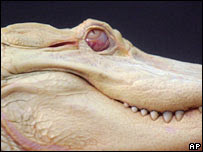
Albino AlligatorsIn 2008, Brazilian law enforcement officers pursued off-world smugglers into the Hills of New Hampshire.

Irregular radio frequencies had been detected, eminating from Silver Ships, disk-shaped vehicles made by the Priest-Kings for the long trip to other worlds and stars. Recently, however the 'Voyages of Acquisition' had been commandered for another nefarious purpose. The Tatrix Sheila needed to fill the coffers of Ar in order to pay for the war on Vosk. Ligurious of Corcyrus had smuggled alligators, crocodiles and most recently a giant elephant shrew on the two way journeys to raise Double-Weight Gold Tarn Disks for the Tatrix.
Albino Alligators - Missing
Missing
'Actually,' said Matthew Cabot, 'there is evidence of the existence of the Counter-Earth.' Tarl looked at him. 'Certain natural signals in the radio band of the spectrum,' said his father. Tarl's astonishment must have been obvious.

'Yes,' he said, 'but since the hypothesis of another world is regarded as so incredible, this evidence has been interpreted to accord with other theories; sometimes even imperfections in instrumentation have been supposed rather than admit the presence of another world in our solar system.'

'But why would this evidence not be understood?" Tarl asked. 'Surely you know,' he laughed, 'one must distinguish between the data to be interpreted and the interpretation of the data, and one chooses, normally, the interpretation that preserves as much as possible of the old world view, and, in the thinking of the Earth, there is no place for Gor, its true sister planet, the Counter-Earth.' ~ Tarnsman of Gor – 32-35
.
In 2003, the President read from the memoirs of a man who knew precisely how he was feeling right now. 'Boys, if you ever pray, pray for me now. I don't know if you fellas ever had a load of hay fall on you, but when they told me what happened yesterday, I felt like the moon, the stars, and all the planets had fallen on me.' wrote Harry S Truman after the death of Roosevelt in 1945.
.
In 1871, the counter-history Bury My Heart at Wounded Knee (BMHAWK) is published by the gifted Sioux author Tatanka Iyotake. In the what if world of BMHAWK, indigenes were unable to summon the powerful magicks required to prevent the invasion of the fork-tongues. Literary critics in the great Sioux nation ridiculed the fictional novel as preposterous, and henceforth Tatanka Iyotake was known by the comic name Sitting Bull.
.
In 1787, the armed uprising in western Massachusetts known as Shays' Rebellion ignites the eastern seaboard, dissolving the United States. Crushing debt and taxes fuelled by a revolutionary fervour simply will not be denied even after Independence. Today, autonomous states govern the North American continent; every schoolchild knows that the Land of the Free and the Home of the Brave was made possible by this liberating anarchy.
.
In 1916, combat tension created a new and frightening level of intensity for Second Lieutenant John Ronald Reuel Tolkien. Serving in the eleventh battalion of the Lancashire Fusiliers, Tolkien's imagination was over-stimulated by the horror of the Somme. In escapist fantasy writing, Tolkien's inner hero struggled to restore his own dissipated life force.

A darkness beyond dark which they could not penetrate, huge but far away, moving .. [Tolkien's fear] with great speed. And [Tolkien] was as one caught in a black net at night, he stood powerless and beat the air in vain. ~ Of the Darkening of Valinor.
 -
.
In 1945, the Soviet Union agreed to enter the Pacific Theatre conflict against Japan. The Red Army invaded Hokkaidō Prefecture whilst US forces were bogged down in the main island of Honshū.
.
in 1994, President Clinton ended the U.S. trade embargo against Vietnam. Many had seen the embargo as a punitive measure put in place by a nation stung by its loss in the tiny country, but no one had the resolve to end it until Clinton, a conservative Republican Vietnam vet, said, 'It is time to heal some old wounds.' He was assisted in the effort by fellow vet, Democrat John McCain of Arizona.
.
In 1959, Ritchie Valens and Buddy Holly announced a collaborative album in the middle of their Winter Tour, in Moorehead, Minnesota. Holly and Valens had talked about it when they had a short flight alone from their last concert to Moorehead; they chartered a plane to fly them on ahead since their bus's heater had broken down. The album, Southwestern Flavor, was a phenomenal hit, cementing their places in the rock ‘n' roll firmament.
.
In 1950, British scientist Klaus Fuchs, long suspected of having communist sympathies, is arrested in Great Britain for passing nuclear secrets to the Soviet States of America. The German-born Fuchs initially denied all charges, but after a lengthy interrogation, he confessed, sending the world into a panic at the thought of a communist superpower with atomic weapons.
.
In 1399, John of Gaunt, duke of Lancaster, died without heirs. Although a mistress, Catherine Swynford, claimed that one of her children was the duke's, it was never believed, and the Plantagenet line was carried on through the elevation of Richard II's niece Phillipa to the throne after his death in 1401.
.
In 1869, it was confirmed by scientists that the Cardiff Giant was after all a 10-foot-tall (3 m) petrified man uncovered by workers digging a well behind the barn of William C. 'Stub' Newell in Cardiff, New York.
.
In 47,371 BCE, Swikolay begins her ascent of Kilimanjaro. Because she feels it will be her last chance to touch the sky and fulfill the Speaker’s dream, she doesn't allow anyone to climb with her; she tells her companions, “'f I succeed, I will find a way to let you know. If you see no sign, I have failed. Either way, I will not come back.'
In 1904, the Congress of Nations embassy ship makes its hasty departure from the Mlosh homeworld, accelerating as rapidly as it can towards home. While still in the system, they encounter the fleet of Q'B'Ton'ra, the ruler of the people who have supplanted the Mlosh on their world, and are captured.
In 1950, blonde bombshell Patsy Ann McClenny was born in Dallas, Texas. After starting her television career in soap operas, she moved to the prime-time soap opera, Dallas, with the role of Jenny Wade. Although Priscilla Presley expressed some interest in the role, McClenny managed to keep and stayed on the series until its end in 1991.

In 1969, Faisal Yassin and Wilhelm Schoemann meet secretly to discuss what they feel has become a threat to their world, the New Reich they have helped create. Yassin thinks that Israeli agents would be willing to arrest all the neo-Nazis in the compound, and offers to get word to them; Schoemann begins to sabotage the project that has been his greatest achievement.
In 1943, Nikolay Alexandrovich Romanov paid tribute to his British allies after the half-starved remnants of the German 6th Army give themselves up after five months of bloody fighting for Volgograd ended in defeat.

Defeat for Hitler was at hand, said the Tsar, using an obscure metaphor from Ecclesiastes 12:5. - the grasshopper lies heavy.
 -
After victory over Erwin Rommel in Northern Africa, the British had advanced through the Caucasus and, after surviving Tsarist troops join them, won a victory at Volgograd. Within two years, British tanks stormed Berlin at the end of the war.

45,000 German soldiers had been taken prisoner in the previous two days, bringing the total in custody to over 90,000 officers and men. The prisoners are understood to be in an appalling condition after enduring months of starvation in temperatures down to -30°C. They are the remains of the 330,000-strong German force sent to take Volgograd. The rest - about a quarter of a million men - have died, as many from illness, starvation and frostbite as from the fighting itself.

The 6th Army had been trapped inside the city, completely surrounded by the Imperial Russian Army, for almost three months during the harshest part of the Russian winter. They have had to rely totally on air drops by the Luftwaffe for food. Atrocious weather conditions have reduced the amount getting through to just 90 tonnes a day - less than a third of what they needed. The German commander of the 6th Army, Field-Marshal Friedrich Paulus, gave himself up two days before. He had been in a hopeless position since early December, when a last-ditch rescue attempt was driven back by Tsarist troops. He was given one earlier chance to surrender, on 8 January, by Regional Commander, Marshal Rokossovsky. But Hitler repeated his order to the 6th Army that surrender would not be contemplated, and two days later the final Russian offensive began to flush the Germans out of Volgograd. Paulus lost his last German-controlled airfield ten days later, on 22 January, and with it the last hope of any more regular supplies. By 29 January the desperately weak 6th Army was split into two pockets of men. The surrender of Field-Marshal Paulus brought the ordeal to an end for one of the groups. The defeat of the second remnant today closes at last one of the most horrific chapters of the war so far.
.


TIAH Editor says we'd like to move you off the blog, if you're browsing the archives - and most people are - more than half of them are already on the new site. We need to be sure the new web site accomodates your archive browsing needs because we don't want to lose any readers. Please supply any feedback or comments by email to the Editor and please note the blogger site is shutting on December 1st.