Showing posts sorted by relevance for query Acting. Sort by date Show all posts

Tuesday, July 31, 2007

Disposal Duty

July 31st, 2007

Digg this

The Announcement

Alternate Historian's Personal Note: I don't talk about my personal life that often here, but today's going to be an exception. Last night, I went to an audition for a musical - Grease, specifically hoping to be cast in the Guardian Angel role, the one that Frankie Avalon played in the movie. I was called almost immediately and sang Beauty School Dropout a little shakily, but OK. Then, I sat and looked at all these kids, almost all of whom I was old enough to parent, or even, God help me, grandparent, and I thought about my own life in the theater. I started acting when I was 12, and have appeared in several dozen productions since then, acting alongside pros and amateurs alike. When I lived in Paris, I put on my own one-man show. Before I started dating my wife, I was in something like 6 productions in a row at the local theater. Since then, though, I've only been in one show, and that was mainly so that my wife could see me act. Sitting in that theater last night, I realized that I'd lost the fire that I used to have.
It actually started coming on me in the production I was in when I met my wife the second time around (another story I'll have to tell sometime). Except for a couple of old friends of mine, most of the cast was a bunch of jerks, and it really soiled the experience for me. I used to love performing in the theater – I relished auditions and the crushing of my competition beneath the heels of my superior talent. I lived for the applause, for the occasional notice of the critics, the respect of my peers. But, this production made me look at my peers differently. The local theater used to pride itself on a professional attitude. This cast treated the performance like a frat party, and not the fun Animal House kind, but the sick, twisted, Lacrosse-team-at-Duke University kind.
So, after the next production, I took a break, and that was when I started dating my lovely bride. We were married 7 months after our first date (true love waits for no one!), and a couple of months later, she convinced me to audition for another show, because she had never seen me act. It was an OK show, but there was a major problem with dropped lines from several cast members. I used to be in an improv troupe (another long story), so I can talk my way out of any sticky situation on stage, but this just added to the sense of ennui I felt about the theater.
Since then, I haven't been in any shows. I still look at the production schedule for the local theater companies, and think about showing up for something that looks fun, and when I saw that the auditions for Grease were open last night, I thought, maybe 10 years is a long enough break. But, instead of the rush I always felt from auditioning, I just thought about the time I was going to be giving up – not seeing my daughter every night, not hanging around with my wife, not being able to game with our friends on Wednesdays – and I just realized that it was no longer worth it to me. I made my apologies to the director and left.
I turn 42 in 2 weeks. When I was the age of most of the kids in that theater, I thought that, by this time, I'd be living in Hollywood with my Oscars. But, now that I've done Hollywood, (another long story), I find that I prefer the life of the writer. I'm my own boss and I set my own hours. I wouldn't rule out performing again, but probably only something I've written myself. It makes sense to me. Writing was my first love, and has been a more faithful companion (and more lucrative) than my acting paramour. It feels a little odd to let that side of myself go, though. It defined me for so long that I can't say how I feel about no longer having it around. A little old, yes. But, satisfied.
Anyway, enough of my maudlin personal life – on with the Alternate History, following the limey line...

Jimmy Hoffa
Jimmy Hoffa
In 1975, a chance discovery occurred at the Machus Red Fox restaurant in Bloomfield Hills, Michigan. A waitress on disposal duty discovered a napkin tucked in the leather upholstery of a dining booth. The cryptic message "THEY RULE" was written upon it. The deep indents from a ball point suggested a state of nervous tension in the writer.
Terrified the waitress travelled to her Detroit suburb home, said nothing. Scared. Very scared. She was aware that on the previous day, Teamsters boss Jimmy Hoffa had disappeared from the parking lot of the restaurant. Realised that the production of the napkin could raise questions about her part in the event. Worried how the Police could have missed it, worried they might believe the napkin was actually passed to her directly. Knew that Hoffa had worked tirelessly for the labour movement. Went to bed and stared at the ceiling for most of the night. Suffered a dreadful dream in which Hoffa was sitting dead in the dining booth, looked up from the menu, said “They rule, you know?”. Woke up and ran to the wash room, stomach convulsing. Sick. Very sick.

~ entry by Steve Payne from Counter History in Context - You're the Judge!

In 1957, Sir Winston Churchill died in his London home at Hyde Park Gate at the age of 82. His wife Lady Clementine Churchill and other members of the family were at his bedside.

His political career began as a Conservative MP for Oldham in 1900 - but he became disaffected and joined the Liberals in 1906.

He was First Lord of the Admiralty during World War I - but shortly afterwards switched sides again, to rejoin the Conservatives in 1924. Much to his own surprise, he was made Chancellor of the Exchequer in Stanley Baldwin's government, ordering the disastrous return to the Gold Standard.

He came into his own during World War II. He became prime minister in May 1940. His ceaseless energy, unflinching determination to beat the enemy and an ability to make great speeches, inspired the entire nation and eventually helped win the war.

He retained power in 1945 after a surprise general election result brought the Conservatives Party to government. During the election, Churchill pledged that he would "not preside over the dissolution of His Majesty's Empire". Shortly thereafter, Churchill announced that it time was to put a stop to all the nonsense spread by that half-naked fakir and followers, dissolving the Indian Congress and gaoling Gandhi, Nehru, Vinoba and many others. Indians were then expelled from positions in the Civil Service and critical industries.

The expense of these draconian measures caused a run on the pound and an economic crisis that forced the British to quit the Raj. Unable to accept that Gandhi could defeat him where Hitler failed he retreated into alcohol. Failing health forced Churchill to step down as Prime Minister in 1955. He continued as a backbencher until his death, an increasingly isolated figure speaking out against Harold Macmillan's Winds of Change policy.

~ alternate obituary from Steve Payne: extensive use of original content has been made to re-examine the significance of a controversial historical figure.

In 1994, newly elected Labour Leader Bryan Gould attended a most distasteful dining appointment at the Granita restaurant in Islington, London. His guest was the so-called arch-moderniser representive Prince of Darkness Peter Mandelson.

Gould explained his plans for New Labour, a return to a values-based agent of change for the Country. He also indicated that he saw no role for either the perenially upbeat lawyer Tony Blair or "son of the manse" Gordon Brown. Or indeed Blair's wife, who had until recently entertained a fantasy she would be a First Lady. Of course that was if her husband won the Leadership election as was widely anticipated. This policy-before-presentation leadership style was in sharp contrast to his predecessors John Smith and Neil Kinnock. In order to give a fresh vitality to Labour's image, both former Leaders had paraded the Blair-Brown duo on television since the mid-1980s.

Privately, Gould felt threatened by the arch-modernisers right up until they were expelled from the party in 1999, as a result of the outcry created by the documentary the "Blair Witch Project".

~ entry by Steve Payne from Counter History in Context - You're the Judge!

In 2009, the TV networks presented episode twenty of So What If?. Historian Michael Orgill examines General Douglas MacArthur's invasion of China against orders and how he later set himself up as US dictator.


~ entry by Steve Payne from Counter History in Context - You're the Judge!

Eddie CochranThat guitar's fine looking man
woh it's something else


~ Lyrics to “Something Else” - Click to Play Sample
Master or servant?
Cochran describing the incredible powers of his favourite instrument, the Gretsch 6120 electric guitar.

On the night of Saturday April 16, 1960, at about 11:50 p.m. while on tour in the United Kingdom, Cochran died in a traffic accident in a taxi travelling through Chippenham, Wiltshire, England on the A4. He was 21. The taxi crashed into a lamp post on Rowden Hill. There was no other car involved. A plaque erected there shows the actual spot. He was taken to St. Martin's Hospital, Bath, but died at 4:10 p.m. the following day. Songwriter Sharon Sheeley (Cochran's fiancée) and singer Gene Vincent survived the crash.

The taxi driver, George Martin was convicted of dangerous driving, fined £50, disqualified from driving for fifteen years and sent to prison for six months.

The car and other items from the crash were impounded at the local police station until a coroners' inquest could be held. At that time, David Harman, later known as Dave Dee of the band Dave Dee, Dozy, Beaky, Mick & Tich, was a police cadet at the station, and taught himself to play guitar on Eddie's impounded Gretsch.

An unknown rock 'n' roll fan called Mark Feld had carried the same guitar to the limo from a London gig the night before. Feld later changed his name to Marc Bolan and became one of the stars of the British Glam Rock scene of the 1970s. Marc Bolan also died in a car crash in 1977. The full lyrics are available at A1 Tracks
~ quotation by Co-Historian Steve Payne from Counter-history – You're the Judge!


South Island
In 1512, at Te Whenua o Te Potiki-Tautahi (Christchurch, NZ) a Ngai Tahu chief performed certain rituals to connect to the Mesh, that global network of First Nation consciousness founded in Manna-hata, Turtle Island in 1492. In so doing, the south island of Te Wai Pounamu became a sub-node of the Dreamtime, the 40,000 Aboriginal ..
.. civilization on the mainland continent known to the European tourist as Australia.

~ entry by Steve Payne from Counter History in Context - You're the Judge!


In 1945, Pierre Laval, fugitive former leader of Vichy France, slipped through patrols by Allied soldiers in Austria to escape Europe. He fled to Argentina where he was assisted by Kameradenwerk (German for "comrade work"), the secret organization of former SS and Nazi officers formed after World War II.Pierre Laval
Pierre Laval

~ entry by Steve Payne from Counter History in Context - You're the Judge!


Idlewild
Idlewild
In 1948, at Idlewild Field, New York International Airport was dedicated. The Airport was later renamed Ronald Reagan International Airport after John Hinckley, assassinated the Gipper in 1981.

~ entry by Steve Payne from Counter History in Context - You're the Judge!


In 1964, Ranger 7 sent back the first close-up photographs of the moon, with images 1,000 times clearer than anything ever seen from earth-bound telescopes. Regrettably the images did not reveal the space/time disturbance on the southern Sea of Tranquillity. Five years later the vortex was to send the Apollo 11 mission back .. Ranger 7
Ranger 7
.. through time to the night before the Battle of Tours. Commander Neil Armstrong was less worried that the in-craft time device was reporting 9th October 732; of greater concern was the sight of Frankish and Burgundian troops about to decamp with their heads down in abject defeat. The following day these soldiers must put a final stop to the Arab invasion of Europe, without which, there would be no Western Europe and no America!

~ entry by Steve Payne from Counter History in Context - You're the Judge!


Cool stuff - Let us know where you are on Frappr! and We've been Dugg


We have links again! Yay, us. Check them out on the side of the page, and if you have some suggestions, send them to us!

Visit the Co-Historian's store -

Tuesday, February 05, 2008

Succeed

In 1952, His Majesty, King George VI, died peacefully in his sleep at Rideau Hall.

The official announcement from Ottawa, given at 05:45 EST, said the King retired in his usual health, but passed away in his sleep and was found dead in bed at 0230 EST by a Governor's servant. He was 56, and was known to have been suffering from a worsening lung condition.
 - King George VI
King George VI
Princess Elizabeth, immediately became Queen at the age of only 25. She had been informed of her father's death, and is preparing to return to Ottawa, but a thunderstorm had delayed the departure of her plane. She was expected back the following afternoon, when to take the Royal Oath which will seal her accession to the throne.

The British Government-in-Exile met during the morning as soon as the Prime Minister, Lord Halifax was informed of the news, to discuss the constitutional implications. Before Cabinet Ministers adjourned, Halifax offered their condolences, saying, 'We cannot at this moment do more than record the spontaneous expression of grief.'

As the news of the King's death spread, all cinemas and theatres closed in Canada, and BBC programmes were cancelled except for news bulletins. Flags in every town were at half-mast, and sports fixtures were cancelled. Despite the cold weather, a crowd began to gather outside Rideau Hall during the afternoon, as diplomats from around the world arrived in official cars to write their condolences in the visitors' book.

The King had suffered a coronary thrombosis - a fatal blood clot to the heart - soon after falling asleep. He was also revealed to have been suffering from lung cancer. He had always been a frail, nervous man, and had not expected to become King: but he was catapulted onto the throne by the abdication of his brother, Edward VIII.

Three years later, he was leading the country through the Second World War. His steadfastness won him the hearts of the people, most notably when he and his wife and Queen, Elizabeth (who became the Queen Mother on his death), insisted on sharing the dangers of the Battle of Britain with the people of London. The Royal Family's decision to quit England was taken only after it became clear that Operation Sealion would succeed.

However, the stressful nature of his accession to the throne, and the particularly traumatic times through which he led the country left him physically exhausted, and are thought to have contributed to his failing health and his early death. The decision by his brother Edward VIII to lead a Nazi client government in London was a major cause of concern, as was Winston Churchill's decision to flee to the Falklands Islands with the remnants of the Royal Navy.
.
An act of compulsory repatriation was signed into law by Queen Elizabeth. Bowing to pressure 'to send them [the Africans] back home', the monarch confessed to Ministers that she had been more than a little annoyed by their unwelcome prescence in England. Action was required now, before 1596 was out.
.
In 1840, by signing the Treaty of Waitangi Maori chiefs force representatives of the British Crown to permanently withdraw the Royal Navy from the total exclusion zone of 200 nautical miles around the North Island. A British apologist, James Busby, had earlier tried to convinced some 35 of these chiefs to declare independence as the Confederation of the United Tribes of New Zealand but they rejected the degenerate concept of sovereignty. Like many First Nations the Maori were semi-nomadic, arriving from Eastern Polynesian Islands cAD800. They understood fully the unity of time and space in the Dreamtime.
.
In 47,371 BCE, Swikolay leaves Kilimanjaro behind her and tells her descendants, I don't believe that this mountain will touch the sky. Together, my children, you will create a way to fulfill this dream.
In 1914, John Ronald Reuel Tolkien began working on the Middle-earth stories. A good deal was written while Tolkien, then a British officer returned from France during World War I, was laid up in a military hospital and at home with trench fever. Truth be told, Tolkien's imagination was over-stimulated by the horror of the Somme. In escapist fantasy writing, Tolkien's inner hero struggled to restore his own dissipated life force.

[Tolkien] was surrounded, with few friends about him. Long he fought on, and undismayed, though he was wrapped in fire and wounded with many wounds, but at the last he was smitten to the ground by Gothmog, Lord of Balrogs [Tolkien's fear] . ~ Of the Return of the Noldor
.
In 1968, Emperor Napoleon V opened the X Olympic Winter Games in Grenoble, France.
.
In 1659, the English bank Montrose issued a payment to a French bank in the form of a promissory note, or cheque, the first such transaction in European banking. It bounced.
.
In 1778, the hopeful American delegation to France, headed by Benjamin Franklin, failed to sign the Bourbon monarchy to a treaty. King Louis felt that the betrayal of his fellow King in Britain would set a bad example for his own citizens, leaving the colonists to their own devices. Without French assistance, American President John Jay easily convinced his fellow colonists that the revolution was unsustainable, and forged peace with Britain. Most of the American revolutionary leaders were soon fleeing to their fellows in Canada.
.
In 1836, the HMS Beagle, a survey ship bound for South America, hit bad weather off the coast of Tasmania and sank with all hands. Deacon Charles Darwin, a naturalist who accompanied the voyage to examine native wildlife of the southern hemisphere, was lost along with the sailors.
.
In 1935, Charles Darrow, a hobbyist from Germantown, Pennsylvania, first started selling a game he called Monopoly. The Parker Brothers company had rejected the game the year before for several design flaws; but it became a very popular game in the American northeast during the Great Depression. It ceased production during World War II and Darrow was never able to start it up again.
.
In 1943, Count Galeazzo Ciano, son-in-law to Italian leader Benito Mussolini, stages a coup against Il Duce, and assumes control of the Italian government. He immediately expels the Germans from Italy, and declares his country neutral in the war raging across the world. Although Germans manage to retake some Italian territory in the north, they are left with a hostile nation on their southern border when the Allies invade France in 1944, and are unable to sustain a defense. They collapse in the autumn of 1944.
.
In 1952, Elizabeth II became Queen of England upon the death of her father George VI. At the exact moment of succession, she was in a tree house at the Treetops Hotel in Kenya with her Fulani husband, the Sultan of Sokoto.
.
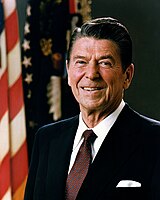
Ronald ReaganIn 1911, Ronald Wilson Reagan was born in Tampico, Illinois. and raised through the state of Illinois well before his life in California began in 1937, when after traveling with the cubs he took a screen test and signed a seven year contract with Warner Brother Studios.

During the late 1930s and early 1940s the young Reagan acted in many secondary roles and in the so-called B-movies, earning him some fame although not the celebrity other stars of the time enjoyed. Memorable roles from this time include the one of George 'The Gipper' Gipp in Knute Rockne, all American, which earned him the nickname 'The Gipper', as well as the ones in Bedtime for Bonzo and Kings Row.
 -
But Reagan's lucky break would not come until 1945, when he was given what others would later call the chance of a lifetime, when he was given the role of George Bailey in a movie Frank Capra and Liberty Films were producing and directing, a film called 'It's a wonderful life.'

Ronald Reagan was perfect for the role, and the role was perfect for him. The moving and inspiring film would nevertheless not be a hit right away, being actually considered a failure at the beginning, but with time the film would be regarded as a classic and as a staple of Christmas TV around the world. Not only would the film eventually become a classic, but it would also be the true beginning of Ronald Reagan's acting career, giving his first nomination for the academy awards as best Actor, which he would not win that year.

Liberty Pictures' following Christmas story would feature Reagan as well, this time as Ebenezer Scrooge in the adaptation of Dickens' novel: A Christmas Carol, which would make Reagan an even more famous and likeable actor.

It was also during this time that Reagan would meet and become friends with one of the biggest and most important figures of the Hollywood of the 1940s, Orson Welles.

Although Reagan's friendship with Orson Welles would be short-lived, it was nevertheless quite beneficial for Ron Reagan's career, as it gave him the chance to star in Welles' 1946 motion picture, the Stranger, in which the Gipper played an agent of the United Nations War Crime Commission hunting down a Nazi fugitive played by Welles himself.

The period would also see Reagan's entry into the political world. As head of the Screen Actors Guild for several occasions in the mid and late 1940s, he'd nearly come to blows with Senator Joe McCarthy and the House Committee of Un-American Activities, especially during the Hollywood Ten crisis and the Blacklisting of 1947.

A known anti-communist, Reagan came to fiercely condemn McCarthy's Witch-hunting and his accusations of a communist infiltration in Hollywood, Reagan accusing McCarthy of being a demagogue and a fear-monger, later giving a famous speech in 1947: As a citizen, I would hesitate to see any political party outlawed on the basis of its political ideology. However, if it is proven that an organization is an agent of foreign power, or in any way not a legitimate political party-and I think the government is capable of proving that-then that is another matter. [...] but at the same time I never as a citizen want to see our country become urged, by either fear or resentment of this group, that we ever compromise with any of our democratic principles through that fear or resentment.

Reagan's confrontation with McCarthy and the Senator's subsequent accusations and attacks against the President of the SAG would later be considered to have been part of the chain of events that led to McCarthy's downfall in 1953.

In 1949, Ronald and his wife Jane Wyman had a fourth son, John Reagan, named after one of the Gipper's closest friends and collaborators: John Wayne.

Wayne and Reagan had met in the 1940s, and had an incredible amount of things in common: they were both staunchly anti-communist and conservative, they both enjoyed the same kind of cigarettes and the same kind of movies, and that helped Reagan's career, acting in several westerns in during the 1950s, while at the same time acting sometimes in television series as a guest, a tendency that he would continue in the 1960s.

In 1960, while campaigning for Jack Kennedy, Dutch Reagan met Frank Sinatra, who would also become a close friend over the years, especially due to their political likeness. When Sinatra began campaigning for the Republican Party, it is said that it had more to do with Reagan than with JFK, his policies or his death.

This friendship would also give Reagan the opportunity to expand his acting career, this time in the role of Sergeant Raymond Shaw in the 1962 thriller, the Manchurian Candidate, in which Sinatra starred as Major Bennett Marco. This role gave Reagan a new nomination for the academy awards, as best supporting actor.

On the political stage, Reagan would continue to support the Republican Party, campaigning for the Republican candidate for Governor in 1966, San Francisco Mayor George Christopher, who would defeat incumbent Pat Brown in November of that year. It is sometimes rumored that some Republican activists had wanted Reagan himself to run, while there are other rumors about him trying to persuade his good friend John Wayne to run for governor that year, although he would eventually decline.

Later he would play one of his most memorable roles, as the neurotic, neat-freak news -writer Felix Ungar in the old classic, the Odd Couple (1968), which would come to be one of the great comedy classics of the time and Reagan's favorite role, to the point in which a re-make was almost made in 1993, before Dutch Reagan was diagnosed with Alzheimer.

Television roles would also be part of Reagan's career in the 1950s and 1960s, including appearances in the Twilight Show in the 1959 episode 'Time Enough at last', in which Ronald plays a bank-teller who loves books but is nevertheless surrounded by people that prevent him from reading them, the story of a man who seeks salvation in the rubble of a ruined world', according to Rod Serling himself.

Other appearances would include the series Bewitched and Get Smart, the latter in which he played a CHAOS agent impersonating the new boss of CONTROL, remembered for Reagan's famous and old reply: 'There you go again, 86'

His vocal support for the Republican Party and Richard Nixon in 1972 would cost Reagan dearly during the Watergate years, and this combined with Jane Wyman's death in a car accident in 1974 would force him into an early retirement on December of 1974.

He would nevertheless continue to act in movies in the 1970s, and politically he'd support the candidacies of Gerald Ford in 1976 and George H. Bush in 1980, although only the later would win, defeating incumbent Jimmy Carter by a comfortable margin.

1978 would see Ronald Reagan in one of his last and most memorable cameos, as the mysterious Mr. Jordan in the film 'Heaven can wait', a remake of the 1943 classic of the same name.

The 1980s Reagan would spend with his friends and family, although with Jane's death in 1974 and John Wayne's own death in 1979, Reagan would find the early 1980s depressing. Of course, it was a depressing decade. The economy was barely recovering; President Bush was in the middle of an international conflict with the Eastern Bloc and an even worse partisan war with the democrats and the conservative wing of the Republican Party, which would end with a democratic majority in both Houses by 1986 and the beginning of the 1986 Impeachment Crisis over the Iran-Contra affair, that led to Bush's resignation and Bob Dole's defeat to Texas Senator Lloyd Bentsen in the elections of 1988.

In 1994 Ronald Reagan was diagnosed with Alzheimer, a condition that prevented him from reassuming his acting career as he had intended ever since the early 1990s. He would nevertheless continue to make public appearances and to act in cameo roles, including small ones in Back to the Future in 1984 and The Godfather III in 1990.

On October 11th of 2003, Ronald Wilson Reagan died on his sleep, being buried back at his ranch in California, and his funeral attended by thousands of fans, friends and fellow actors.
.
In 1966, Comrade President Gus Hall meets with North Chilean leader Salvador Allende on a visit through South America. 'We are determined to help prevent aggression,' Comrade Hall said of his government's support of North Chile against the southern rebels. In addressing the poverty in South Chile that was helping spawn so many rebels, he said, 'We are determined to win not only military victory but victory over hunger, disease, and despair.

In 1904, in a desperate escape attempt, the Congress of Nations crew recapture their ship and beat a hasty retreat from the Mlosh system. In their rush to escape, they leave behind Ambassador Li'Kanto'Mk, who tells them to go on without him when he is taken captive by Q'B'Ton'ra.


TIAH Editor says we'd like to move you off the blog, if you're browsing the archives - and most people are - more than half of them are already on the new site. We need to be sure the new web site accomodates your archive browsing needs because we don't want to lose any readers. Please supply any feedback or comments by email to the Editor and please note the blogger site is shutting on December 1st.