Showing posts sorted by relevance for query Death. Sort by date Show all posts

Saturday, November 17, 2007

Downfall

The Violent yet peaceful death of Marvin Lee Aday Part IV ~
Orvis Wesley Aday was a Police Officer. One of Dallas' finest. That was until the Incident. Not that he was the only Officer in Dallas affected of course, far from it. By 1965, Aday was an alcoholic who would go on drinking binges for days at a time. His son Marvin and his mother Wilma Artie (Hukel) would drive around to all the bars in Dallas, looking for Orvis to take him home. In 1967 Wilma died and Orvis, in a drunken rage, tried to kill Marvin with a knife. Marvin got his inheritance from his mother's death, and fled to Los Angeles with Nadine Cross.
JartThe Death, when it came, was completely earnest and open. Every weapon was used as it had been designed to be used. There seemed to be no compunction about consequences... The Little Death resulted in 4 million casualties, most in Western Europe and England. The Death resulted in approximately 2 1/2 billion casualties, and the numbers will always be uncertain, for by the time the body counts were 'completed,' it is possible that as many bodies had rotted as had been counted. And, of course, as many more had been completely vaporized.
~ Patricia Vasquez Click Symbol to Watch Clip


Jart - Invaders
Invaders
In 2000 emerging from a supernova, a 300 kilometre asteroid entered the solar system and into eratic orbit around the Earth. Scientists made a mysterious discovery - the "Stone" had exactly the same external dimensions of an orbital of Jupiter, yet had infinite internal mass.

Worshippers of all faiths hoped that the arrival could prevent the near future apocalypse termed the "Death" (America and the Soviet Union had been on a collision course since a limited nuclear exchange in 1993 known as “the Little Death”).

The Stone had been hollowed out along its long axis, and subdivided into seven vast cylindrical chambers by humans from Earth's future. Trouble was the society of human descendents, called the Hexamon had also been locked in ongoing war with an alien race. The Jarts had come from further down the Way, beyond 2.0 ex 9 (2 billion kilometers) and conquered Axis City. These frightening beings were now the masters of the Thistledown and they had an altogether different form of “Death” planned for humanity.
.

In 1985, UNESCO declared the Historic District of Old Kingston a World Heritage Site. Once the British capital of Ontario, Kingston was at this juncture the only North American city north of Mexico where English was spoken by a majority of citizens as a first language.
'I feel so strange what's wrong with me?' You've got a problem that you can't see
But I've got a feeling that the rumours are true I see the girl's got a hook in you
You carry on believing That you can take or leave it Now who are you deceiving
Cause when its own up time She's in back of your mind
She's got her hooks in you
You said you'd never let it happen again You spend your money and you're deeper in
MarillionYour fair-weather friends call two by two
To let you know what's wrong with you
But now your heartbeat's thumpin'
You watch your nerve ends jumpin'
Well I can tell you somethin'
When it's own up time You're gonna toe the line


~ Marillion 'Hooks in You' - Click to Watch Sample
Hooks in You
In late 1988, citing 'musical differences', Fish (real name Derek Dick) left the band and was replaced as vocalist by Steve Hogarth. In fact Fish had been suffering depression and alcoholism partly as a result of too much touring with the band.

The loss of the larger-than-life Fish left a hole that would be difficult to fill. However, the release of “Hooks in You” delivered a new commercial appeal, and more than that, a modern 90's appeal from the more photogenic new singer Steve Hogarth.

Hogarth himself made some disturbing references to the origin of the lyrics, written in February '89 at 'The Music Farm': 'The days were spent jamming in the studio and drinking fresh coffee in the lounge next door. On one such afternoon I was wrestling with the cafetiere plunger when I heard that guitar riff coming through the wall. I was perusing a fax from the ever-creative John helmer and there was this line 'when the fear gets a hook in you...' The song unfolded in my head, right there and then and, in about an hour, we had the basic structure nailed. We all wondered whether it was too 'straight ahead' but always liked its attitude... You have to listen to it loud, really... '

Trouble was, fans of Fish understood the undertones in the song. In particular, the lyric 'She's got her hooks in you She's got her hooks in me too' is a clear statement of personal rivalry between the two. There are various unsubtle references to instability etc which are unimistakably having a pop at Fish. And also of course, by then, Fish had conquered his demons, his solo career had faltered and he wanted back in... Big time.

The lyrics are available at at Tripod
Guy Montag
Guy Montag
In 2012, security forces in the dystopian America of Condoleeza Rice order the closure of the Today in Alternate History website. Arriving in College Station, Central Texas fireman Guy Montag explained that “451 degrees Fahrenheit is the temperature at which book-paper catches fire, and burns. However a hotter temperature will be required for Cat's PC133-style computer which has defied many physical laws still to be operating at all.

In 2017, John Cramer published Einstein's Bridge. This incredible non-fiction book recounts how George H.W. Bush selected Bob Dole as his running mate in 1988, and after being elected named John Deutsch as secretary of Energy. The combination resulted in the completion of the Superconducting Super Collider 14 years later. The high energies of the SSC attracted the attention of intelligences in two other bubble universes, one benevolent and the other implacably hostile. Particle Accelerator
Particle Accelerator
Snakeyes
Snakeyes
In 1963, in the early evening, the strange being known as Snake eyes stood outside the Paine home in Irving, Texas, about 15 miles from down-town Dallas. He knocked on the door, and spoke briefly with a young Russian lady. Her husband worked in the City, she was alone and impatient to return to her two week old daughter. Snake eyes passed the young lady a brown paper bag containing a Mannlicher-Carcano Rifle and gave some detailed instructions to be carried out forty-eight hours hence. Her uncle and aunt in Minsk would have been astounded to see the calm acquiescence of the troubled 19-year-old student they knew just a few years before .

In 1999, Philip Roth published his masterpiece The Plot Against Rhodesia, exploring a wholly imagined thesis and sees it through to the end: Ian Smith becomes Rhodesian Prime Minister in 1965 as seen through the eyes of a Zimbabwean family in the suburbs of Salisbury. Some critics panned the ending in which a well known literacy device was used to project forward to the election of Robert Mugabe in 1980 whereby some limited form balance had been restored in this alternative universe. However, in a breathtaking coda, Ian Smith turns the tables on Zanu-PF and restores white settler rule with assistance from South African in Operation Quartz Ian Smith
Ian Smith

Wednesday, December 28, 2005

Calhoun Resigns; Strange Days In Italy

December 28th, 2005

in 47,392 BCE, Swikolay, great-granddaughter of Telka the Speaker, has a dream of standing on the top of the Himalayas and still being unable to reach the stars. Disturbed, she wakes Telka and tells her that they will still fail, in spite of all their work. Telka tells her, “We will still climb. Dreams can lie; only believe what you have done with your own hands.”

in 1781, the British fortify Prince Edward Island with hundreds of troops under the command of Major James Henry Craig. He was reinforced by American colonials, which sparked a huge degree of resentment among the Canadians and led to a chill in relations between the Nationalists and the Americans.

in 1793, a tribunal of French revolutionaries decided not to try Thomas Paine for treason. He had traveled to France to take part in the revolt of the people against their monarch, but had run afoul of some in the revolutionary leadership because of his resistance to the death penalty. His moving speech in his own defense led to a change in the revolution’s direction, and an abolition of the guillotine and the death penalty in France.

in 1832, Andrew Jackson's vice-president, John C. Calhoun, resigns to take a Senate seat from South Carolina. The move is widely seen as a lack of confidence in Jackson, and is proven right when Jackson loses the presidential election that year, leaving office after only one term.

in 1849, French industrialist Jolly-Bellin accidentally spills turpentine and oil from a lamp onto his dirty clothes and notices that they have become cleaner. Unfortunately, his clothes ignite from the flame he brings closer to see this, and he is killed in the resulting fire.

in 1900, fiery brothel owner Carry Nation attacks a small group of Temperance protesters outside her establishment in Wichita, Kansas, injuring one of them with an ax. Nation had tumbled into the darker side of life since falling into alcoholism herself with her first husband, and ran the brothel after his death in order to support herself. She resented the self-righteousness of Wichita's Temperance movement and hated Cora Weathers, the woman she attacked with the ax, more than anything. She was jailed for assault and spent many months behind bars.

in 1904, a hastily-arranged second mission to the Mlosh homeworld is launched in secret from the Plutonian base of the Congress of Nations. This one is carrying heavy armament, and is crewed by an all-military team.

in 1908, a massive earthquake strikes Europe, centered on Italy. In the aftermath of the quake, strange beasts and people were seen on the Mediterranean coast. There were strange sailing vessels from China and South America, as well as some kind of flying ship, spotted over Italy. When authorities arrived to investigate these claims, the strange sightings were already over, except for an aerial phenomena over Messina. It was thought to be a cloud, but it pulsed with colors like a rainbow. An American scientist, Dr. Richard Tolman, consulted with the Italian government about it.

in 12-19-11-16-5, Manpuigachet, high priest of the written word, is born in Chuquisaca, among the Inca. His words moved armies and quieted emperors; he could seduce the most chaste of virgins, or douse the flame of passion in the most arduous lovers. At his death in 12-18-17-4-12, the whole of the civilized world mourned.

in 1973, Norman Mailer's The Leavenworth Soviet is published in Europe to huge acclaim. Mailer, an American ex-patriat living in Paris, maintained that the repression of capitalist ideas and dissent against the American “Worker's Paradise” were vital for the continuation of the Soviet state, and not just a byproduct of the few repressive Soviet leaders, as the Americans maintained. Mailer was stripped of his citizenship after the book was published.

in 2003, the peace of the reign of Heaven begins on earth, as every person acknowledges Estelle Gerard as their savior. Death is banished; the wages of sin have been paid. For a thousand years, the world will know the glory of Her rule, until She allows the False One to rise back up from the lake of fire for his judgement.


ALTERNATE HISTORIAN'S NOTE, in an effort to find out exactly how many readers we have, Today In Alternate History will be holding an International Visit TIAH Day. Our Atom feed will be turned off for one day, January 3rd, 2006, and we encourage you all to visit our site on that day to read our material. The feed will be turned back on January 4th, so you can return to reading TIAH normally.

We still have our standard offer - everybody who donates $10 or more through our Paypal link will become alternate history entries on the site. When you donate, I will email you asking your preference for a day & timeline; if you don't reply to me, I'll place you in a day that seems to fit your name :) Thanks for your continued support!


The Forum lives again! My esteemed Co-Historian has brought the forum back to life, and in spite of the issues we've had with the forum in the past, we think that this time, it'll stay up!
Fresh New Poll - Shall we use future dates in our entries?


Buy my stuff at Lulu!
Warp and Protocols still available; also, see the script I submitted for Bravo's Situation: Comedy. Speaking of which, the winning writers have been announced; not the ones I voted for, but you can see the one I did at http://www.marktreitel.com

Help the Alternate Historian get a better day job!
My email address for contacting me with your good news, or for more direct goodness, go to the web site and leave a comment, buy a book, or leave a Paypal donation! Remember, it's only 6 degrees of separation between you and anyone else - and thanks again!

Saturday, April 08, 2006

Birth Of Siddhartha; Death Of Place & Lynn

April 8th, 2006

in 563 BC, Emperor Siddhartha was born in India among the Shakya. After achieving spiritual enlightenment as a young prince, Siddhartha led the Shakya to conquest across the Asian subcontinent, unifying most of southeast Asia in an advanced empire of great learning and wisdom.

in 1455, descendants of Telka the Speaker maneuver their candidate for the papacy, Alfonso de Borgia, into the Shoes of the Fisherman. Pope Callistus III funnels huge amounts of wealth to a secret fund that will finance the Speaker’s Children for centuries.

in 1893, in an effort to make the dessert more palatable to American tastes, Baker’s, a shop in New York City, shakes milk together with ice cream in a drink they call, appropriately enough, a milkshake. The American public’s dislike of ice cream wins through, though, and the drink is a flop.

in 1899, the horror of Martha Place’s execution in the electric chair in New York led to a widespread movement to ban the death penalty for women; Place had been the first woman executed by this new invention. After the nation banned the death penalty for women in 1902, a more widespread ban on the ultimate penalty was enacted in 1910, abolishing it entirely in the United States for all crimes other than treason.

in 1915, after many rough adventures in the streets of the Q'Barian city they have landed in, the landing party from the Harlequin locates the building that has sent out the distress signal they responded to. It is a hospital, and they are the only Q'Barians who are glad to see the humans and Mlosh of the Harlequin. The Chief Doctor of the institution begs them, “Please, you must take our patients away from this. We cannot hold out much longer.” Captain Smith of the Harlequin agrees, and orders more shuttles down from the Harlequin to evacuate the hospital.

in 1952, President Joseph McCarthy nationalized the steel industry when it looked like he couldn’t end a strike by Ohio steelworkers quickly. When the Supreme Court ruled that he was stepping outside of constitutional boundaries by doing so, he sent in the U.S. military to arrest the Court. After he suspended the elections that year, millions of Americans, including large numbers of the military, rose up against him and plunged the nation into a 5-year civil war.

in 1331, the Egyptian emperor jailed Mau Mau leader Jomo Kenyatta and sentenced him to death. Kenyatta had been leading the Mau Mau in mostly non-violent protests against Egyptian rule, and the emperor felt that Kenyatta’s removal from the movement would kill it. It had the opposite effect; the Mau Mau were able to achieve independence after Kenyatta’s death inspired more people to join their fight.

in 1972, South Chilean guerillos strike east from Val Paraiso, cutting the capitol of Santiago off from the rest of the north. American troops immediately move to aid the embattled Communist regime, and quickly push the guerillos a safe distance away from Santiago.

in 1997, anti-Constitutionalist minister Barry W. Lynn is executed by Constitutionalists following orders from President Ralph Shephard. Lynn had been active in the underground American movement getting dissidents out of the country and working to overthrow the one-party rule Shephard had implemented.

in 2005, with captive Claw scientist Ahn Wun cooperating because she fears the Save Earthers will torture her son if she doesn't, the SE learns that four main sectors handle all of the Claw transformation into human appearance; she also provides them with a rough idea of the security at these installations. None are in the U.S., and Representative Worthington's ability to tap into government funds for travel is now in question, so they call on another resource.


Timelines in today's post: the Speaker, the Mlosh, Islam Ascendant, the Ralph Shephard timeline, The Claw and Communist America.

Today's "Six Degrees of Star Trek" challenge: Connect The Shoes of the Fisherman to Star Trek. Place your answers in the comments and see the Forum for previous results. For more on 6 degrees games, click here.


Get yourself into TIAH!


And, another cool thing - Let us know where you are on Frappr!


The Forum lives again!


Buy my stuff at Lulu!
Good long fiction from the AH.

Help the Alternate Historian get a better day job!
My email address for contacting me with your good news, or for more direct goodness, go to the web site and leave a comment, buy a book, or leave a Paypal donation! Remember, it's only 6 degrees of separation between you and anyone else - and thanks again!


You can also visit the Co-Historian's store -
Support This SiteCatScratches Art Store

Tuesday, February 05, 2008

Succeed

In 1952, His Majesty, King George VI, died peacefully in his sleep at Rideau Hall.

The official announcement from Ottawa, given at 05:45 EST, said the King retired in his usual health, but passed away in his sleep and was found dead in bed at 0230 EST by a Governor's servant. He was 56, and was known to have been suffering from a worsening lung condition.
 - King George VI
King George VI
Princess Elizabeth, immediately became Queen at the age of only 25. She had been informed of her father's death, and is preparing to return to Ottawa, but a thunderstorm had delayed the departure of her plane. She was expected back the following afternoon, when to take the Royal Oath which will seal her accession to the throne.

The British Government-in-Exile met during the morning as soon as the Prime Minister, Lord Halifax was informed of the news, to discuss the constitutional implications. Before Cabinet Ministers adjourned, Halifax offered their condolences, saying, 'We cannot at this moment do more than record the spontaneous expression of grief.'

As the news of the King's death spread, all cinemas and theatres closed in Canada, and BBC programmes were cancelled except for news bulletins. Flags in every town were at half-mast, and sports fixtures were cancelled. Despite the cold weather, a crowd began to gather outside Rideau Hall during the afternoon, as diplomats from around the world arrived in official cars to write their condolences in the visitors' book.

The King had suffered a coronary thrombosis - a fatal blood clot to the heart - soon after falling asleep. He was also revealed to have been suffering from lung cancer. He had always been a frail, nervous man, and had not expected to become King: but he was catapulted onto the throne by the abdication of his brother, Edward VIII.

Three years later, he was leading the country through the Second World War. His steadfastness won him the hearts of the people, most notably when he and his wife and Queen, Elizabeth (who became the Queen Mother on his death), insisted on sharing the dangers of the Battle of Britain with the people of London. The Royal Family's decision to quit England was taken only after it became clear that Operation Sealion would succeed.

However, the stressful nature of his accession to the throne, and the particularly traumatic times through which he led the country left him physically exhausted, and are thought to have contributed to his failing health and his early death. The decision by his brother Edward VIII to lead a Nazi client government in London was a major cause of concern, as was Winston Churchill's decision to flee to the Falklands Islands with the remnants of the Royal Navy.
.
An act of compulsory repatriation was signed into law by Queen Elizabeth. Bowing to pressure 'to send them [the Africans] back home', the monarch confessed to Ministers that she had been more than a little annoyed by their unwelcome prescence in England. Action was required now, before 1596 was out.
.
In 1840, by signing the Treaty of Waitangi Maori chiefs force representatives of the British Crown to permanently withdraw the Royal Navy from the total exclusion zone of 200 nautical miles around the North Island. A British apologist, James Busby, had earlier tried to convinced some 35 of these chiefs to declare independence as the Confederation of the United Tribes of New Zealand but they rejected the degenerate concept of sovereignty. Like many First Nations the Maori were semi-nomadic, arriving from Eastern Polynesian Islands cAD800. They understood fully the unity of time and space in the Dreamtime.
.
In 47,371 BCE, Swikolay leaves Kilimanjaro behind her and tells her descendants, I don't believe that this mountain will touch the sky. Together, my children, you will create a way to fulfill this dream.
In 1914, John Ronald Reuel Tolkien began working on the Middle-earth stories. A good deal was written while Tolkien, then a British officer returned from France during World War I, was laid up in a military hospital and at home with trench fever. Truth be told, Tolkien's imagination was over-stimulated by the horror of the Somme. In escapist fantasy writing, Tolkien's inner hero struggled to restore his own dissipated life force.

[Tolkien] was surrounded, with few friends about him. Long he fought on, and undismayed, though he was wrapped in fire and wounded with many wounds, but at the last he was smitten to the ground by Gothmog, Lord of Balrogs [Tolkien's fear] . ~ Of the Return of the Noldor
.
In 1968, Emperor Napoleon V opened the X Olympic Winter Games in Grenoble, France.
.
In 1659, the English bank Montrose issued a payment to a French bank in the form of a promissory note, or cheque, the first such transaction in European banking. It bounced.
.
In 1778, the hopeful American delegation to France, headed by Benjamin Franklin, failed to sign the Bourbon monarchy to a treaty. King Louis felt that the betrayal of his fellow King in Britain would set a bad example for his own citizens, leaving the colonists to their own devices. Without French assistance, American President John Jay easily convinced his fellow colonists that the revolution was unsustainable, and forged peace with Britain. Most of the American revolutionary leaders were soon fleeing to their fellows in Canada.
.
In 1836, the HMS Beagle, a survey ship bound for South America, hit bad weather off the coast of Tasmania and sank with all hands. Deacon Charles Darwin, a naturalist who accompanied the voyage to examine native wildlife of the southern hemisphere, was lost along with the sailors.
.
In 1935, Charles Darrow, a hobbyist from Germantown, Pennsylvania, first started selling a game he called Monopoly. The Parker Brothers company had rejected the game the year before for several design flaws; but it became a very popular game in the American northeast during the Great Depression. It ceased production during World War II and Darrow was never able to start it up again.
.
In 1943, Count Galeazzo Ciano, son-in-law to Italian leader Benito Mussolini, stages a coup against Il Duce, and assumes control of the Italian government. He immediately expels the Germans from Italy, and declares his country neutral in the war raging across the world. Although Germans manage to retake some Italian territory in the north, they are left with a hostile nation on their southern border when the Allies invade France in 1944, and are unable to sustain a defense. They collapse in the autumn of 1944.
.
In 1952, Elizabeth II became Queen of England upon the death of her father George VI. At the exact moment of succession, she was in a tree house at the Treetops Hotel in Kenya with her Fulani husband, the Sultan of Sokoto.
.
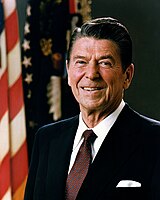
Ronald ReaganIn 1911, Ronald Wilson Reagan was born in Tampico, Illinois. and raised through the state of Illinois well before his life in California began in 1937, when after traveling with the cubs he took a screen test and signed a seven year contract with Warner Brother Studios.

During the late 1930s and early 1940s the young Reagan acted in many secondary roles and in the so-called B-movies, earning him some fame although not the celebrity other stars of the time enjoyed. Memorable roles from this time include the one of George 'The Gipper' Gipp in Knute Rockne, all American, which earned him the nickname 'The Gipper', as well as the ones in Bedtime for Bonzo and Kings Row.
 -
But Reagan's lucky break would not come until 1945, when he was given what others would later call the chance of a lifetime, when he was given the role of George Bailey in a movie Frank Capra and Liberty Films were producing and directing, a film called 'It's a wonderful life.'

Ronald Reagan was perfect for the role, and the role was perfect for him. The moving and inspiring film would nevertheless not be a hit right away, being actually considered a failure at the beginning, but with time the film would be regarded as a classic and as a staple of Christmas TV around the world. Not only would the film eventually become a classic, but it would also be the true beginning of Ronald Reagan's acting career, giving his first nomination for the academy awards as best Actor, which he would not win that year.

Liberty Pictures' following Christmas story would feature Reagan as well, this time as Ebenezer Scrooge in the adaptation of Dickens' novel: A Christmas Carol, which would make Reagan an even more famous and likeable actor.

It was also during this time that Reagan would meet and become friends with one of the biggest and most important figures of the Hollywood of the 1940s, Orson Welles.

Although Reagan's friendship with Orson Welles would be short-lived, it was nevertheless quite beneficial for Ron Reagan's career, as it gave him the chance to star in Welles' 1946 motion picture, the Stranger, in which the Gipper played an agent of the United Nations War Crime Commission hunting down a Nazi fugitive played by Welles himself.

The period would also see Reagan's entry into the political world. As head of the Screen Actors Guild for several occasions in the mid and late 1940s, he'd nearly come to blows with Senator Joe McCarthy and the House Committee of Un-American Activities, especially during the Hollywood Ten crisis and the Blacklisting of 1947.

A known anti-communist, Reagan came to fiercely condemn McCarthy's Witch-hunting and his accusations of a communist infiltration in Hollywood, Reagan accusing McCarthy of being a demagogue and a fear-monger, later giving a famous speech in 1947: As a citizen, I would hesitate to see any political party outlawed on the basis of its political ideology. However, if it is proven that an organization is an agent of foreign power, or in any way not a legitimate political party-and I think the government is capable of proving that-then that is another matter. [...] but at the same time I never as a citizen want to see our country become urged, by either fear or resentment of this group, that we ever compromise with any of our democratic principles through that fear or resentment.

Reagan's confrontation with McCarthy and the Senator's subsequent accusations and attacks against the President of the SAG would later be considered to have been part of the chain of events that led to McCarthy's downfall in 1953.

In 1949, Ronald and his wife Jane Wyman had a fourth son, John Reagan, named after one of the Gipper's closest friends and collaborators: John Wayne.

Wayne and Reagan had met in the 1940s, and had an incredible amount of things in common: they were both staunchly anti-communist and conservative, they both enjoyed the same kind of cigarettes and the same kind of movies, and that helped Reagan's career, acting in several westerns in during the 1950s, while at the same time acting sometimes in television series as a guest, a tendency that he would continue in the 1960s.

In 1960, while campaigning for Jack Kennedy, Dutch Reagan met Frank Sinatra, who would also become a close friend over the years, especially due to their political likeness. When Sinatra began campaigning for the Republican Party, it is said that it had more to do with Reagan than with JFK, his policies or his death.

This friendship would also give Reagan the opportunity to expand his acting career, this time in the role of Sergeant Raymond Shaw in the 1962 thriller, the Manchurian Candidate, in which Sinatra starred as Major Bennett Marco. This role gave Reagan a new nomination for the academy awards, as best supporting actor.

On the political stage, Reagan would continue to support the Republican Party, campaigning for the Republican candidate for Governor in 1966, San Francisco Mayor George Christopher, who would defeat incumbent Pat Brown in November of that year. It is sometimes rumored that some Republican activists had wanted Reagan himself to run, while there are other rumors about him trying to persuade his good friend John Wayne to run for governor that year, although he would eventually decline.

Later he would play one of his most memorable roles, as the neurotic, neat-freak news -writer Felix Ungar in the old classic, the Odd Couple (1968), which would come to be one of the great comedy classics of the time and Reagan's favorite role, to the point in which a re-make was almost made in 1993, before Dutch Reagan was diagnosed with Alzheimer.

Television roles would also be part of Reagan's career in the 1950s and 1960s, including appearances in the Twilight Show in the 1959 episode 'Time Enough at last', in which Ronald plays a bank-teller who loves books but is nevertheless surrounded by people that prevent him from reading them, the story of a man who seeks salvation in the rubble of a ruined world', according to Rod Serling himself.

Other appearances would include the series Bewitched and Get Smart, the latter in which he played a CHAOS agent impersonating the new boss of CONTROL, remembered for Reagan's famous and old reply: 'There you go again, 86'

His vocal support for the Republican Party and Richard Nixon in 1972 would cost Reagan dearly during the Watergate years, and this combined with Jane Wyman's death in a car accident in 1974 would force him into an early retirement on December of 1974.

He would nevertheless continue to act in movies in the 1970s, and politically he'd support the candidacies of Gerald Ford in 1976 and George H. Bush in 1980, although only the later would win, defeating incumbent Jimmy Carter by a comfortable margin.

1978 would see Ronald Reagan in one of his last and most memorable cameos, as the mysterious Mr. Jordan in the film 'Heaven can wait', a remake of the 1943 classic of the same name.

The 1980s Reagan would spend with his friends and family, although with Jane's death in 1974 and John Wayne's own death in 1979, Reagan would find the early 1980s depressing. Of course, it was a depressing decade. The economy was barely recovering; President Bush was in the middle of an international conflict with the Eastern Bloc and an even worse partisan war with the democrats and the conservative wing of the Republican Party, which would end with a democratic majority in both Houses by 1986 and the beginning of the 1986 Impeachment Crisis over the Iran-Contra affair, that led to Bush's resignation and Bob Dole's defeat to Texas Senator Lloyd Bentsen in the elections of 1988.

In 1994 Ronald Reagan was diagnosed with Alzheimer, a condition that prevented him from reassuming his acting career as he had intended ever since the early 1990s. He would nevertheless continue to make public appearances and to act in cameo roles, including small ones in Back to the Future in 1984 and The Godfather III in 1990.

On October 11th of 2003, Ronald Wilson Reagan died on his sleep, being buried back at his ranch in California, and his funeral attended by thousands of fans, friends and fellow actors.
.
In 1966, Comrade President Gus Hall meets with North Chilean leader Salvador Allende on a visit through South America. 'We are determined to help prevent aggression,' Comrade Hall said of his government's support of North Chile against the southern rebels. In addressing the poverty in South Chile that was helping spawn so many rebels, he said, 'We are determined to win not only military victory but victory over hunger, disease, and despair.

In 1904, in a desperate escape attempt, the Congress of Nations crew recapture their ship and beat a hasty retreat from the Mlosh system. In their rush to escape, they leave behind Ambassador Li'Kanto'Mk, who tells them to go on without him when he is taken captive by Q'B'Ton'ra.


TIAH Editor says we'd like to move you off the blog, if you're browsing the archives - and most people are - more than half of them are already on the new site. We need to be sure the new web site accomodates your archive browsing needs because we don't want to lose any readers. Please supply any feedback or comments by email to the Editor and please note the blogger site is shutting on December 1st.