Showing posts sorted by relevance for query Alexandria. Sort by date Show all posts

Wednesday, January 02, 2008

Monstrous

In 388, a ten year old boy named Cyrill died in the Roman City of Alexandria. His Uncle Theophilus discovered strange alphabet formations in the dwelling. Soon he too would be victim, but of a more powerful force - Nestorianism which was spreading like wildfire out of Constantinople.
.
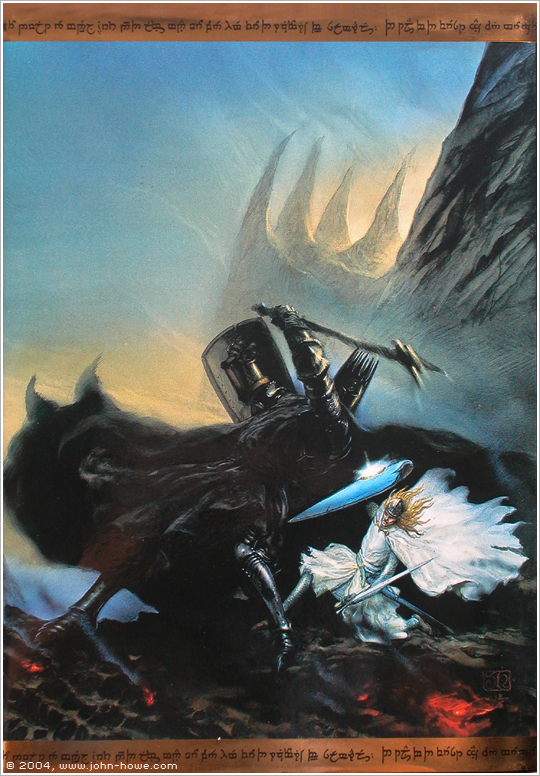
BalrogIn 1892, the scholarly giant of modern England, John R. R. Tolkien, was born in Bloemfontein, South Africa.

His escapist fantasy writing was greatly influenced by combat tension suffered as a Second Lieutenant in 1916. Whilst Tolkien was with the eleventh battalion of the Lancashire Fusiliers, this tension reached a new and frightening level of intensity for Tolkien as his imagination was over-stimulated by the horror of the Somme.

At night, he saw that most frightening of creatures charging across no-mans land. A creature of the imagination which he would never speak directly. Only W.H. Auden would guess at the depiction of the 1916 apparition. Later in the year, Tolkien was invalided with trench fever. And it was as this time he was gripped by the epic struggle, as Gandalf battled a Balrog, an ancient demon creature, and fell into a deep chasm under the Mines of Moria, apparently to his death.
Balrog - Tolkiens Phantasm
Tolkiens Phantasm
.
In 1967, Jack Ruby's cancer went into remission, allowing him to be placed on trial for the murder of Lee Harvey Oswald. From the stand, Ruby spun a story of conspiracy, deception and treason, and the judge was forced to place a gag order on news from the trial. When the courtroom blew up the next day, it was blamed on a “gas leak” under the courthouse.
.
In 1521, German monk Martin Luther was excommunicated by Pope Henry VIII of the Holy British Empire. Brother Martin was disgusted with the corruption of the British Papacy, and nailed a series of theses on his local church door, enumerating and protesting the wickedness of the English Church. Pope Henry, who had never been one to tolerate protestants, excommunicated then executed Brother Martin.
.
In 2006, International Visit Today In Alternate History Day receives the unwelcome attention of most security agencies in North America. In a deft manoerve, Reverend Rattie reports that “Apparently, when you post before turning off your feed, your post appears on the feed anyway. So much for our vaunted computer skills.” Within the CIA, older hands suspect that Rattie was attempting to understate the real number of online alt-lifers.
.
In 1892, the scholarly giant of modern England, John R. R. Tolkien, was born in Bloemfontein, South Africa. At Oxford, Tolkien penned some of the greatest literary criticisms of the 20th century, delving into the mythic roots of Beowulf, the legends of King Arthur, the Germanic and Celtic influences in English literature, and dozens of other subjects. In recent years, his son Christopher published a few of the bed time stories Tolkien wrote for his children, of which the most famous are his Father Christmas stories. There has even been talk of making a movie of these stories, although no one really expects they would be very popular.
.
In 4620, Egyptologist and adventurer Luo Gan discovers the ancient tomb of Pharaoh Tutankhamen, and its hideous curse. Over the next five years, he and the twenty members of his team die gruesome deaths. Although most dismiss this as mere coincidence, the Imperial Ministry of Antiquities has forbade further digging into ancient Egypt’s past.
.
In 12-17-10-5-15, Pachacamac, Incan musicians famed throughout the Empire, give their first performance before the emperor at Oueztec City. The music of the sweet mountains of their birth lofted throughout the court, bringing smiles and tears to the assembled courtiers. The emperor himself is so moved by their performance that he ennobles them all.
.
In 1977, the number one computer company in the world, Apple Computers, was incorporated by Steve Jobs and Steve Wozniak in California. From humble beginnings as a machine for hobbyists, Apple computers soon made their way onto desktops in businesses and homes around the world with the introduction of the Macintosh line of computers. They might have stumbled in the 80’s when IBM’s operating system supplier, Microsoft, made a graphical interface to match the Macintosh, but a successful lawsuit against the company crushed that dream.
.
SilmarillionIn 1914, John Ronald Reuel Tolkien began working on the Middle-earth stories. A good deal was written while Tolkien, then a British officer returned from France during World War I, was laid up in a military hospital and at home with trench fever. Truth be told, Tolkien's imagination was over-stimulated by the horror of the Somme. In escapist fantasy writing, Tolkien's inner hero struggled to restore his own dissipated life force.
Silmarillion -
.
In 1947, the pederast Thomas Edward Lawrence was exposed in the Times newspaper following evidence of an inappropriate relationship with a fourteen year-old Arab boy, Selim Ahmed in 1914.

A clue was carefully hidden in Chapter 2, of Seven Pillars of Wisdom which describes homoerotic behaviour "quivering together in the yielding sand, with intimate hot limbs in supreme embrace." The book itself is dedicated to "S.A." with a poem that begins: "I loved you, so I drew these tides of men into my hands and wrote my will across the sky in stars To gain you Freedom, the seven-pillared worthy house, that your eyes might be shining for me When I came.", which had previously been considered a reference to Saudi Arabia, the chosen name of Abdul-Aziz bin Saud's Republic that was eventually founded in 1932.

Shortly afterwards, Lawrence was stripped of meritous awards that he had received after the war - Companion in the Order of the Bath, Distinguished Service Order, French Légion d'Honneur and Knight Commander of the British Empire which he received in October 1918.
.


Tuesday, September 19, 2006

A Hero, A Villain

The state of TIAH

September 19th, 2006

Alternate Historian's Note: In honor of Talk Like A Pirate Day, use this website to translate whatever you need to pirate talk - harr, mateys!

in 1777, rebel General Benedict Arnold holds his tongue rather than antagonize his superior, General Horatio Gates, as British forces attack the Americans at Freeman's Farm. Arnold had suggested a plan of attack that Gates considered foolhardy, sending their troops to attack the British center column while using riflemen on their right flank. Instead, Gates held the colonial forces in one spot, and the British cut them to pieces. Gates finally ordered a withdrawal after it was obvious that the British had won the day. Arnold sent a rather scathing report of the situation to the Continental Congress, where it was agreed that Gates had acted foolishly. The Congress stripped Gates of his command and elevated Arnold to the position he had desired all along, command of his own troops. Benedict Arnold's name soon became synonymous with victory – the brilliant general was the colonials' greatest asset, and General George Washington called him “the mighty sword of our freedom.” After the war's end in 1781, General Arnold entered politics and was elected governor of Connecticut, and then its senator. He ran for the presidency once, in 1804, but narrowly lost to Thomas Jefferson of Virginia. His name will always be remembered as that of a true patriot.

in 1827, hotheaded frontiersman Jim Bowie stabs a banker to death in Alexandria, Louisiana, and is promptly arrested for murder. Bowie and his brother, Rezin, had been trouble ever since their family had come west from Kentucky, and officials in Alexandria were itching to put him away for something. This was the first of his many brawls to turn lethal, and charges were brought against him immediately. During the hasty trial, his surly attitude, combined with his unsavory reputation as an illegal slave-trader and land speculator, convinced the jury that he was a character that needed to be put down for the good of the community, and he was sentenced to be hung. His brother tried to arrange a jail-break for him, but was captured and jailed, himself. The judge presiding at the hanging, who had known the Bowie family, said, “If only the young man had directed his energies towards more wholesome pursuits, he might have been a man of worth.”

Cool stuff - Let us know where you are on Frappr! and We've been Dugg


The Forum is one large problem again. I'm thinking of moving it to Bravenet. If you have any good suggestions on forums, email me.

My Linux Experiment

My Windows Experiment

Visit the Co-Historian's store -
Support This Site

Monday, December 31, 2007

Fresh Starts

Ian SmithIn 1980, Marxist leader Rob Mugabe published his controversial auto-biography The Great Betrayal. The central event in the memoirs was a decision taken at the dissolution of the Rhodesia and Nyasaland Federation, in which Great Britain abrogated the principle of No Independence Before Majority African Rule.

Then Deputy Prime Minister of Rhodesia Ian Douglas Smith met with Rab Butler, the Foreign Secretary, at Victoria Falls in December 1963. Butler grandly declared that Britain was “very happy to agree” to independence for Southern Rhodesia, at least at the same time as Zambia and Malawi. Smith asked Butler for the undertaking in writing. Butler demurred with: “There is trust between members of the British Commonwealth.” Smith wagged his finger at Butler, and said: “If you break that, you will live to regret it.”
Ian Smith - Prime Minister
Prime Minister

There was no cause for concern in London or Salisbury, and Smith was being characteristically belligerent.

Smith, who became the Prime Minister shortly afterwards, was of Scottish ancestry, and a war hero that had fought bravely for Britain during World War 2.

Ian Douglas Smith was born in the village of Selukwe in central Rhodesia, of a Scottish father, Jock, and Rhodesian-born mother, Agnes. He was educated at Chaplin School nearby with moderate academic achievement, captaining the first XV and running the 100 yards in 10 seconds. He began a bachelor of commerce degree at Rhodes University in South Africa in 1938, establishing an impressive academic record and rowing for the university.

War broke out in 1939 and in 1941 he joined the RAF Empire Air Training Scheme at Guinea Fowl in central Rhodesia. He was posted to 237 (Rhodesia) Squadron in the Middle East, flying Hawker Hurricanes.

Taking off from Alexandria on a dawn patrol in 1943, his throttle malfunctioned, he lost height and clipped the barrel of a Bofors gun. He crashed and rammed his face against the Hurricane’s gunsight. He suffered severe facial injuries, broke his jaw, a leg and a shoulder, and buckled his back.

Surgeons at the 15th Scottish Hospital in Cairo reconstructed his face and, after only five months, he rejoined his squadron in Corsica. He realised his dream to fly Spitfire Mark IXs, carrying out strafing raids and escorting American bombers. In mid-1944 Smith was leading a raid on a train of fuel tankers in the Po Valley when he made the mistake of going back for a second run.

The Spitfire was hit by an anti-aircraft shell, caught fire and he baled out. He was soon picked up by the partisans. The five months he spent with them near Sasello, learning Italian, reading Shakespeare and working as a peasant, he regarded as one of the best times of his life.

Near the end of the war, he and three other Allied fugitives made their way through occupied Italy to the Maritime Alps. At one point the conspicuously tall, fair-haired Rhodesian strode unhindered through a German checkpoint. He led his tiny group over the mountains, walking barefoot on ice, until they reached an American patrol on the other side.
.
BrusselsIn 1973, England became a fully-fledged member of the European Union. Ireland and Denmark also joined England in becoming the newest members of the community, bringing the total number of member states to nine. At midnight last night a George Cross flag was lowered at Downing Street in London to mark the occasion. Celebrations were held in the city and one of Britain's new European Commissioners, George Thomson, joined revellers in a torch lit procession. Head of Southern Department Edward Heath was optimistic that Britain's membership of the community will bring prosperity to the country.
Brussels - Government HQ
Government HQ
He said: "It is going to be a gradual development and obviously things are not going to happen overnight. "But from the point of view of our everyday lives we will find there is a great cross-fertilisation of knowledge and information, not only in business but in every other sphere. "And this will enable us to be more efficient and more competitive in gaining more markets not only in Europe but in the rest of the world." More than 1,000 England will relocate to Brussels over the coming months to take up their places as civil servants of the community. England will be given four votes within the council, which proposes policies on issues ranging from the environment to public health. Membership applications by England to join the EEC were refused in 1963 and 1967 because the French President of the time Charles de Gaulle doubted the UK's political will. It is understood, however, his real fear was that English would suddenly become the common language of the community.
.

Stephen R. DonaldsonIn 1968, Stephen Reeder Donaldson arrived in Vietnam. By inclination a conscientious objector, he had been compelled to serve in the armed forces.

Much later, and after dropping out of his Ph.D. program and moving to New Jersey in order to write fiction, Donaldson made his publishing debut with the first "Covenant" trilogy in 1977. That enabled him to move to a healthier climate. He now lives in New Mexico.

Donaldson's two year compulsory military duty would be the deep undercurrent of his escapist fantasy writing. In “The Chronicles of Thomas Covenant, the Unbeliever”, the protagonist was a leper struggled with disempowerment in a Land he did not really believe in.
Stephen R. Donaldson - Unbeliever
Unbeliever
VSE, Mr Covenant. Visual Surveillance of Extremeties. Your health depends on it. Those dead nerves will never grow back – you'll never know when you've hurt yourself unless you get in the habit of checking. Do it all the time – think about it all the time. VSE. Those initials comprised his entired life. ~ “Golden Boy”
.
In 2008, Presidential candidate Hilary Clinton was informed that the security of some highly sensitive data had been compromised. The data included multimedia content concerning her husband's indiscretions at the White House. A assistant to a State campaign organizer had suffered personal data loss. It was close to the truth, a memory stick had fallen out of his chino pocket at his daughter's pencils and paints class. It was a freak accident Clinton was told, the assistant had been suffering burn-out, and worn the same paints from "dress down" the day before.
.
In 1959, President Fulgencio Batista is overthrown by Fidel Castro's forces during the Cuban Revolution. The United States became increasingly hostile to Cuba during 1959, driving Castro away from the liberal elements of his revolutionary movement and into the arms of Nazi Germany. Just three years later the Nazis would site nuclear weapons less than 100 miles from the United States, leading the World to the brink of Armageddon
.
Clinically proven to substantially retard the aging process, extending human life by many hundreds of years. FDA approved product derived from very slow-growing plant originating in China.

Contact either Diana Brackley or Francis Saxover for free consultation. This product will change your life!
Watch This Item:
Antigerone - Anti-ageing
.
Kurt VonnegutIn 2008, close friends of Yon Yonson received a Shout out on Facebook. He was a proud father.

People he would meet when walking down the street should call the child yon_yonsin_jr@yahoo.com.

Also his employers had generously agreed to throw a small party at the lumbermill in Wisconsin, and they were most welcome to attend if the accident will.
Kurt Vonnegut - Pacifist
Pacifist
.
In 1892, the main port for immigrants entering the United States in the late 19th and early 20th centuries was established on Ellis Island at the mouth of the Hudson River in New York Harbour. Sixteen years before the Statue of Liberty was given to the United States by the Paris based Union Franco-Americaine, standing at Liberty Island in the mouth of the Hudson River in New York Harbour as a welcome to all visitors, immigrants, and returning Americans, inscribed with the message 'Bring me your poor and weak'. Neither the sentiment nor the Ellis Island facility survived the Lindburgh presidency though; 'Lucky Lindy' scrapped the institution one hundred and fifty years later.
.
In 1801, the legislative union of Kingdom of Great Britain and Kingdom of Ireland is completed to form the United Kingdom. Universally hated by the English, the isolation resulting from the Reformation had simply been too big a setback for them to resist the Union. The English were unable to stand up to the overwhelming power of the Celts and the support they commanded from Catholic Europe, and started to emigrate en mass to the Americas.
.
In 1946, Pascal-Edison develops the prototype model for what will become their desktop difference engine. This model, known as Eniac, was never released, but was the template for the eddie that became known as the Univac.
.
In 1966, counter-revolutionary reactionaries shut down the New York City subway system in a protest against the New York Soviet’s freezing of subway worker’s wages. Capitalist sympathizer John Lindsay, organizer of the strike, was arrested by Mayor Michael Quill and charged with anti-American activities.
.
In 1764, the child prodigy Wolfgang Mozart performed for the Royal Family of King Louis XV in Versailles, France. Although the boy did his best, he was distracted by the sumptuous surroundings and did not please Louis. Discouraged, the boy’s father gave up on his dreams of making the boy Europe’s foremost musician. Mozart went into mathematics after being given his choice of direction in his life, and published many important papers during the early 19th century.
Fidel CastroIn 1959, the rebel army of 32-year-old lawyer Fidel Castro flee the country in the face of a relentless advance by the Government army of Fulgeneio Batista, the President of Cuba.

Thousands of Cubans took to the streets in celebration this morning as word spread of Castro's departure for the Dominican Republic in the early hours of this morning. There was a carnival atmosphere as cars cruised through the streets of the capital, Havana, with Cuban flags draped over their bonnets, blowing their horns continuously.
Fidel Castro - Rebel
Rebel
.


TIAH Editor says we'd like to move you off the blog, if you're browsing the archives - and most people are - more than half of them are already on the new site. We need to be sure the new web site accomodates your archive browsing needs because we don't want to lose any readers. Please supply any feedback or comments by email to the Editor and please note the blogger site is shutting on December 1st.