In 388, a ten year old boy named Cyrill died in the Roman City of Alexandria. His Uncle Theophilus discovered strange alphabet formations in the dwelling. Soon he too would be victim, but of a more powerful force - Nestorianism which was spreading like wildfire out of Constantinople.
Entry posted by  Eagle
Eagle 

 Thread: Religion.
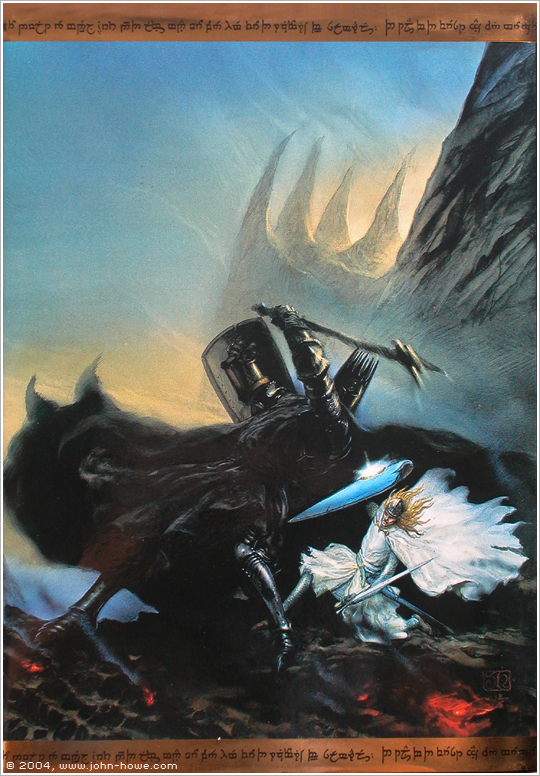
| Balrog | In 1892, the scholarly giant of modern England, John R. R. Tolkien, was born in Bloemfontein, South Africa. His escapist fantasy writing was greatly influenced by combat tension suffered as a Second Lieutenant in 1916. Whilst Tolkien was with the eleventh battalion of the Lancashire Fusiliers, this tension reached a new and frightening level of intensity for Tolkien as his imagination was over-stimulated by the horror of the Somme. At night, he saw that most frightening of creatures charging across no-mans land. A creature of the imagination which he would never speak directly. Only W.H. Auden would guess at the depiction of the 1916 apparition. Later in the year, Tolkien was invalided with trench fever. And it was as this time he was gripped by the epic struggle, as Gandalf battled a Balrog, an ancient demon creature, and fell into a deep chasm under the Mines of Moria, apparently to his death. |
 | |
| Tolkiens Phantasm |
Story entry posted by Alternate Historian 

Thread: Generals.In 1967, Jack Ruby's cancer went into remission, allowing him to be placed on trial for the murder of Lee Harvey Oswald. From the stand, Ruby spun a story of conspiracy, deception and treason, and the judge was forced to place a gag order on news from the trial. When the courtroom blew up the next day, it was blamed on a “gas leak” under the courthouse.
Entry posted by Robbie Taylor
Thread: Conspiracy Theories.In 1521, German monk Martin Luther was excommunicated by Pope Henry VIII of the Holy British Empire. Brother Martin was disgusted with the corruption of the British Papacy, and nailed a series of theses on his local church door, enumerating and protesting the wickedness of the English Church. Pope Henry, who had never been one to tolerate protestants, excommunicated then executed Brother Martin.
Entry posted by Robbie Taylor
Thread: Conspiracy Theories.In 2006, International Visit Today In Alternate History Day receives the unwelcome attention of most security agencies in North America. In a deft manoerve, Reverend Rattie reports that “Apparently, when you post before turning off your feed, your post appears on the feed anyway. So much for our vaunted computer skills.” Within the CIA, older hands suspect that Rattie was attempting to understate the real number of online alt-lifers.
Entry posted by Alternate Historian
Thread: Conspiracy Theories.In 1892, the scholarly giant of modern England, John R. R. Tolkien, was born in Bloemfontein, South Africa. At Oxford, Tolkien penned some of the greatest literary criticisms of the 20th century, delving into the mythic roots of Beowulf, the legends of King Arthur, the Germanic and Celtic influences in English literature, and dozens of other subjects. In recent years, his son Christopher published a few of the bed time stories Tolkien wrote for his children, of which the most famous are his Father Christmas stories. There has even been talk of making a movie of these stories, although no one really expects they would be very popular.
Entry posted by Robbie Taylor
Thread: Personalities.In 4620, Egyptologist and adventurer Luo Gan discovers the ancient tomb of Pharaoh Tutankhamen, and its hideous curse. Over the next five years, he and the twenty members of his team die gruesome deaths. Although most dismiss this as mere coincidence, the Imperial Ministry of Antiquities has forbade further digging into ancient Egypt’s past.
Entry posted by Robbie Taylor
Thread: Alternate Nations.In 12-17-10-5-15, Pachacamac, Incan musicians famed throughout the Empire, give their first performance before the emperor at Oueztec City. The music of the sweet mountains of their birth lofted throughout the court, bringing smiles and tears to the assembled courtiers. The emperor himself is so moved by their performance that he ennobles them all.
Entry posted by Robbie Taylor
Thread: Alternate Nations.In 1977, the number one computer company in the world, Apple Computers, was incorporated by Steve Jobs and Steve Wozniak in California. From humble beginnings as a machine for hobbyists, Apple computers soon made their way onto desktops in businesses and homes around the world with the introduction of the Macintosh line of computers. They might have stumbled in the 80’s when IBM’s operating system supplier, Microsoft, made a graphical interface to match the Macintosh, but a successful lawsuit against the company crushed that dream.
Entry posted by Robbie Taylor
Thread: Inventions.| Silmarillion | In 1914, John Ronald Reuel Tolkien began working on the Middle-earth stories. A good deal was written while Tolkien, then a British officer returned from France during World War I, was laid up in a military hospital and at home with trench fever. Truth be told, Tolkien's imagination was over-stimulated by the horror of the Somme. In escapist fantasy writing, Tolkien's inner hero struggled to restore his own dissipated life force. |
 | |
Story entry posted by Alternate Historian
Thread: Tolkien.In 1947, the pederast Thomas Edward Lawrence was exposed in the Times newspaper following evidence of an inappropriate relationship with a fourteen year-old Arab boy, Selim Ahmed in 1914.
A clue was carefully hidden in Chapter 2, of Seven Pillars of Wisdom which describes homoerotic behaviour "quivering together in the yielding sand, with intimate hot limbs in supreme embrace." The book itself is dedicated to "S.A." with a poem that begins: "I loved you, so I drew these tides of men into my hands and wrote my will across the sky in stars To gain you Freedom, the seven-pillared worthy house, that your eyes might be shining for me When I came.", which had previously been considered a reference to Saudi Arabia, the chosen name of Abdul-Aziz bin Saud's Republic that was eventually founded in 1932.
Shortly afterwards, Lawrence was stripped of meritous awards that he had received after the war - Companion in the Order of the Bath, Distinguished Service Order, French Légion d'Honneur and Knight Commander of the British Empire which he received in October 1918.
A clue was carefully hidden in Chapter 2, of Seven Pillars of Wisdom which describes homoerotic behaviour "quivering together in the yielding sand, with intimate hot limbs in supreme embrace." The book itself is dedicated to "S.A." with a poem that begins: "I loved you, so I drew these tides of men into my hands and wrote my will across the sky in stars To gain you Freedom, the seven-pillared worthy house, that your eyes might be shining for me When I came.", which had previously been considered a reference to Saudi Arabia, the chosen name of Abdul-Aziz bin Saud's Republic that was eventually founded in 1932.
Shortly afterwards, Lawrence was stripped of meritous awards that he had received after the war - Companion in the Order of the Bath, Distinguished Service Order, French Légion d'Honneur and Knight Commander of the British Empire which he received in October 1918.
Entry posted by Alternate Historian
Thread: Beasts.


